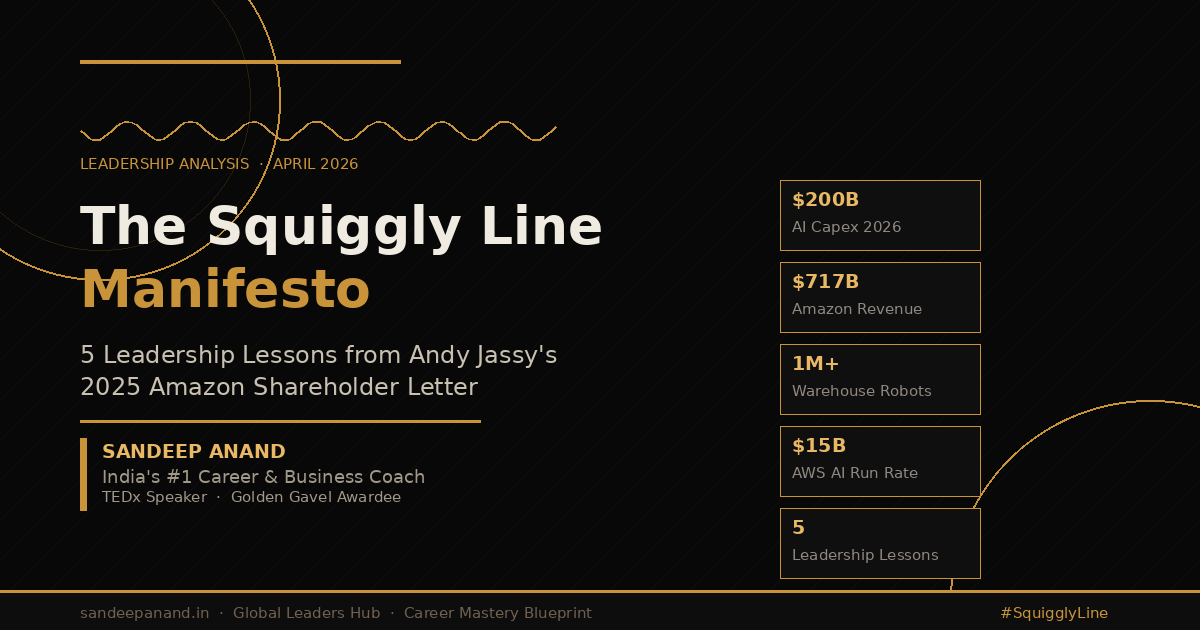
The Squiggly Line
Manifesto
5 Leadership Lessons from Andy Jassy’s 2025 Amazon Shareholder Letter That Every Professional Needs Right Now
Most companies plan for straight-line growth. Amazon plans for squiggly lines. Andy Jassy’s 2025 shareholder letter isn’t a financial update — it is a blueprint for how transformational organisations actually operate.
Every year, Amazon’s CEO publishes a letter to shareholders. Most corporate letters are polished PR. Jassy’s 2025 letter is different. It opens with him recounting how he wanted to be a sportscaster, worked retail and investment banking, failed at his own businesses, and landed at Amazon three days after his last final exam in 1997.
His point? Not exactly a straight line.
He uses a New Zealand indie band — The Beths — and their album Straight Line Was a Lie to frame the entire letter. And what follows is perhaps the most honest, data-rich piece of executive communication to come out of a Fortune 10 company in years. The numbers are staggering. The philosophy is even more powerful.
Here are the five leadership lessons hiding inside those numbers — and why they matter for your career and your organisation in 2026.
Straight Lines Are a Myth — Embrace the Squiggle
AWS, Amazon’s cloud powerhouse now generating well over $100 billion annually, did not follow a grand plan. Its original vision included storage, compute, payments, and human intelligence. Some of those became pillars. Others failed quietly. The first database service got no traction. They rebuilt it. When EC2 — the compute service — launched, it was a single instance type, Linux-only, with no auto-scaling, no load balancing, and no private networking.
Yet enterprises and governments that pundits said would “never” use cloud eventually came — Netflix in 2008, then GE, then the CIA. The CIA chose AWS to build their classified cloud. Not because of a perfect roadmap. Because of relentless iteration.
Progress jumps around; it’ll zig up, then sometimes stall, or zag down, or force you back to the starting line. But the path is rarely straight.
— Andy Jassy, 2025 Shareholder LetterInvent Inflections — Don’t Wait for Them
Amazon isn’t reacting to the future. It is manufacturing it. Jassy details several fronts where the company is creating entirely new categories rather than competing in existing ones.
- Robotics at scale: Over one million robots now operate in Amazon’s fulfillment centres, automating stowing, picking, sorting, and transport — while the company remains one of the largest private employers in the US.
- Rural delivery: Where competitors are retreating from expensive-to-serve rural markets, Amazon committed over $4 billion to expand its rural delivery network. Same-Day customers in rural areas nearly doubled year-over-year.
- Amazon Leo: A low-Earth orbit satellite internet service launching mid-2026, already securing contracts with Delta Airlines (500 planes), AT&T, Vodafone, and NASA. Performance promised at six to eight times better uplink than current alternatives, at lower cost.
- AI infrastructure: AWS AI revenue already at a $15 billion annual run rate in Q1 2026 — growing at 260x the pace AWS itself grew in its first three years.
Pursue Parallel Paths — Because 2 Is Always Greater Than 0
Jassy uses a delightful anecdote about a New York Rangers hockey game with his father to make a deceptively simple point: too many companies chase tidiness over traction. They debate which single path to take for months, and end up doing nothing. Meanwhile, Amazon builds simultaneously on multiple fronts.
Take fast delivery. Three years ago, two-day delivery was the gold standard. Amazon pushed it to one day, then same-day. But instead of choosing one mechanism, they built three in parallel:
- Same-Day Fulfillment Centres (SSDs): 85+ locations carrying 90,000 SKUs. Over 500 million same-day units delivered in 2026 so far.
- Prime Air drone delivery: Scaling to serve communities with 30 million customers by end of year, targeting half a billion packages by end of decade.
- Amazon Now: Ultra-fast 20-minute delivery from micro-fulfillment centres, already operating in India and UAE. In India — 360+ micro-fulfillment centres, 25% month-over-month order growth, with Prime members tripling purchase frequency.
Some companies may have decided to pursue only one of these efforts, arguing for weeks or months which one, all the while pursuing none.
— Andy Jassy, 2025 Shareholder LetterWhen You Find a Real Inflection, Bet Enormous
Jassy is unambiguous: not all inflections are equal. Identifying the truly seminal ones — versus the merely “interesting” ones — requires judgment. And when you find a genuine one, you invest as aggressively as you responsibly can. The investment spikes will invite scrutiny. That is the price of playing for a generation-defining opportunity.
For Amazon, that inflection is AI. And Jassy’s case is grounded in specifics, not hype. He dismissed fears of an AI bubble directly:
We’re not investing approximately $200 billion in capex in 2026 on a hunch. AI is a once-in-a-lifetime opportunity where the current growth is unprecedented and the future growth even bigger.
— Andy Jassy, 2025 Shareholder LetterHis evidence is compelling:
- ChatGPT reached 100 million users in two months — 15 times faster than Instagram, 4 times faster than TikTok.
- OpenAI and Anthropic reportedly each approaching $30 billion in revenue run rates.
- Jassy’s analogy: when Edison opened his first power station in 1882, people saw it as a better light bulb. What they couldn’t see was electricity reorganising every factory and home on Earth over 40 years. AI, he argues, may do the same in four years.
- Amazon’s custom Trainium AI chips already powering a $20B+ annual chip business. If sold to third parties like NVIDIA, the run rate would be approximately $50 billion.
Be Willing to Start Over — Even When It’s Working
Perhaps the most counter-intuitive lesson in the letter is this: Amazon routinely abandons what is working to build what is next. Jassy calls it returning to “a clean sheet of paper” and going back to first principles — even at massive scale.
Alexa, Amazon’s voice assistant, was rebuilt. Bedrock — their AI model serving platform — was architecturally reimagined. Core customer experiences across retail and grocery were dismantled and reconstructed after failed experiments (multiple grocery formats were tried before the current hybrid of Whole Foods + Same-Day perishables + Daily Shop emerged). The grocery business now stands at over $150 billion in gross sales, making Amazon the second-largest grocer in the United States.
None of that was possible without the willingness to let go of previous versions.
If you want to be finding that next zig, you need to be willing to go back to first principles — even if it means imagining customer experiences from a clean sheet of paper.
— Andy Jassy, 2025 Shareholder LetterWhat This Means For You
The Career Translation
Jassy’s letter is about Amazon. But strip away the billions and the satellites, and it is really a letter about how growth actually works — at any scale. If you are a professional navigating 2026, here is what the squiggly line principle means in practice:
- Linear careers will struggle. The professional who optimised for one skill, one company, one title is now the least resilient person in the room.
- Predictable roles will shrink. Jassy’s $200B AI bet confirms what every leading indicator already shows: routine cognitive work will be automated faster than most organisations are prepared to admit.
- AI + adaptability will define winners. The combination of domain knowledge and the ability to navigate uncertainty — not just a single credential — is the new career moat.
- Multiple bets compound. Build a skill adjacent to your core. Grow an audience. Pursue a side project. Not because you need an escape hatch — but because non-linear thinkers create non-linear opportunities.
The question isn’t whether your path is clear. It is whether you are building the capacity to navigate uncertainty — and whether you are placing enough parallel bets to find your next inflection.
Innovation is Chaotic. Compound It Anyway.
Andy Jassy’s 2025 shareholder letter will be studied by business schools, strategy consultants, and investors for years. But the most important readers are the professionals who aren’t running $700 billion companies — the ones deciding whether to stay safe or make a real bet on themselves in a moment that won’t come again.
Amazon’s stock rose 3.6% the day the letter dropped. Not because the numbers were comfortable. Because the vision was credible.
Build a credible vision for yourself. Embrace your squiggles. Place multiple bets. And when you find your inflection — whether it is AI, a new industry, or a capability the market doesn’t yet know it needs — invest in it with everything you have.
Innovation isn’t clean. It’s chaotic, expensive, and often misunderstood. But if you get it right, it compounds for decades.
— Inspired by Andy Jassy’s 2025 Amazon Shareholder LetterReady to Build Your Non-Linear Career?
If this resonated, I work with leaders and professionals to design career strategies that compound — not just careers that survive. Let’s find your next inflection together.
Book a Career Consultation Explore CoursesSandeep Anand
India’s #1 Career & Business Coach · TEDx Speaker · Golden Gavel Awardee
Founder of Global Leaders Hub. Coach to 100,000+ professionals across 40+ countries. Author of the Career Mastery Blueprint. Featured speaker on career strategy, executive presence, and AI-readiness. Based in Hyderabad.