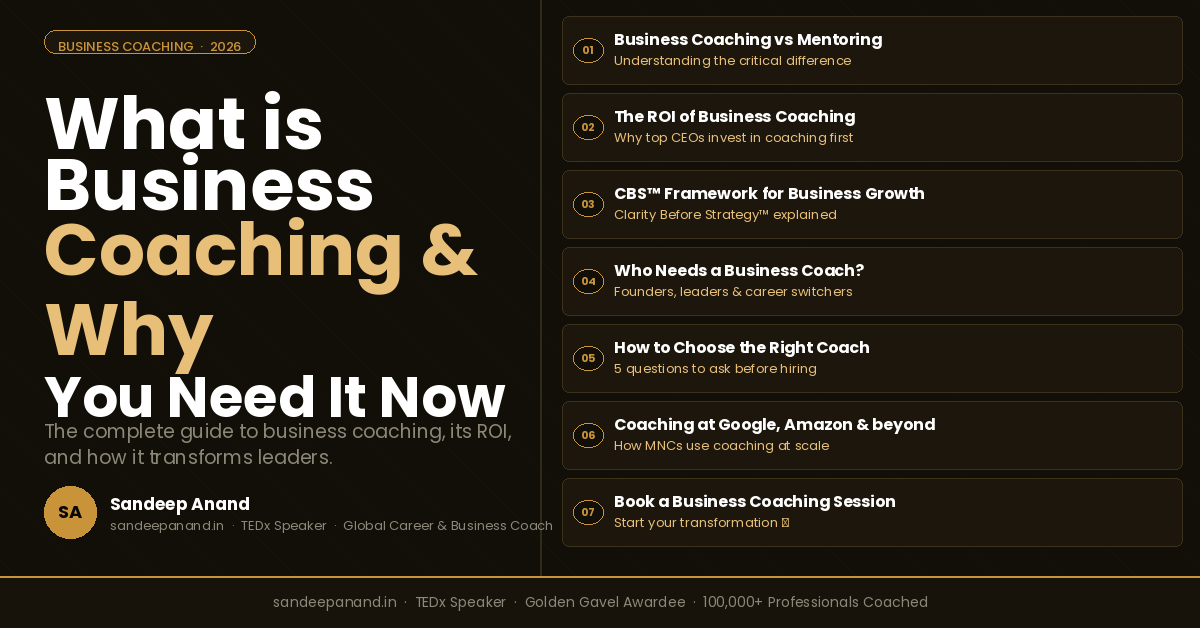
Every world-class athlete has a coach. Every high-performing CEO has an advisor. Every elite professional has someone in their corner helping them see what they cannot see alone. Business coaching is not a luxury — in 2026, it is the highest-leverage investment any serious entrepreneur or leader can make.
Yet despite its extraordinary track record, business coaching remains widely misunderstood. Many people confuse it with consulting, mentoring, or training — and as a result, they either invest in the wrong thing or never invest at all. This guide sets the record straight.
What Business Coaching Actually Is
Business coaching is a structured, goal-oriented professional relationship in which a trained coach works with a business owner, entrepreneur, or leader to help them achieve specific professional outcomes faster and more reliably than they would alone.
A business coach does not run your business for you. They are not a consultant who gives you answers, or a mentor who shares their experience. A business coach asks the right questions, holds up the right mirror, and creates the accountability structures that make you act on what you already know but have been avoiding.
The best analogy is this: a GPS does not drive the car. It gives you clarity on where you are, the fastest route to where you want to go, and real-time recalibration when you take a wrong turn. A great business coach does exactly that — for your career and your company.
Business Coaching vs Mentoring vs Consulting: The Critical Difference
Business Coach
Focuses on your thinking, your decisions, and your actions. Uses powerful questions, frameworks, and accountability to help you achieve your goals. Does not need to have done exactly what you are doing — but must be skilled at helping you think clearly and act decisively.
Mentor
Someone who has walked the path you are on and shares their experience. Mentoring is advice-based and retrospective — the mentor tells you what worked for them. Valuable for industry-specific wisdom but limited by the mentor’s own experience and potential blind spots.
Consultant
A subject-matter expert who is hired to solve a specific problem. Consultants deliver recommendations, reports, and solutions. They are the right choice when you need expertise you do not have. They are the wrong choice when the problem is your own clarity, decision-making, or execution.
In practice, the best business coaches — including Sandeep Anand’s Clarity Before Strategy™ coaching at Global Leaders Hub — combine elements of all three, tailored to what the client needs at each stage.
The Clarity Before Strategy™ Framework
After 18 years of coaching entrepreneurs and business leaders across 40+ countries, one truth has emerged above all others: most business failures are not execution failures. They are clarity failures.
Entrepreneurs invest in marketing before they understand who their customer is. Leaders launch products before they understand what problem they are solving. Professionals change jobs before they understand what they actually want.
The Clarity Before Strategy™ (CBS™) framework, developed by Sandeep Anand, addresses this root cause directly. Before any strategy, tactic, or tool is discussed, the CBS™ framework ensures the entrepreneur or leader achieves precision on: their unique value proposition, their ideal customer or stakeholder, their business model and revenue strategy, and their personal definition of success.
Only once this clarity is established does the coaching shift to strategy, execution, and accountability.
Ready to take action? Your next step starts here.
Book a Business Coaching Session | Explore Coaching Services
The ROI of Business Coaching: What the Evidence Shows
The International Coaching Federation’s Global Coaching Study found that 86% of companies that invested in coaching reported a positive return, with a median ROI of 700%. A separate study by Manchester Inc. found that executive coaching delivered an average ROI of 5.7 times the cost of the programme.
At the individual level, Sandeep Anand’s coaching clients consistently report outcomes including: salary increases of 20–40%, promotions achieved 6–18 months earlier than expected, businesses launched or stabilised within 90 days of beginning coaching, and revenue growth of 30–80% within the first year.
These are not exceptional outcomes. They are what happens consistently when the right coaching methodology is applied to the right client at the right time.
Who Needs a Business Coach in 2026?
Entrepreneurs and Startup Founders
If you are building a business, a business coach is the fastest way to avoid the most expensive mistakes. The average first-time founder spends 18 months figuring out lessons that an experienced coach can share in 60 minutes. The cost of coaching is always lower than the cost of a preventable mistake.
Mid-Career Professionals Seeking Advancement
If you have been in your role for more than two years without a promotion or meaningful salary increase, coaching helps you identify and address the real barrier — which is almost never a skills gap and almost always a positioning, communication, or visibility gap.
Senior Leaders and Executives
The higher you go, the less unfiltered feedback you receive. Business coaching gives senior leaders the rare gift of a completely honest, completely confidential thinking partner who has no agenda other than their success.
Career Changers and Pivoters
Career pivots are among the highest-stakes decisions professionals make. The right coaching engagement can cut the uncertainty, shorten the transition timeline, and increase the probability of landing in the right role at the right level.
How to Choose the Right Business Coach in 2026
1. Look for a Proven Methodology
Generic encouragement is not coaching. Look for a coach who operates from a structured, proven framework — like the Clarity Before Strategy™ methodology — that has delivered measurable results across diverse clients and industries.
2. Check Real Social Proof
Verified reviews on platforms like Google and Trustpilot tell you what you need to know. Sandeep Anand holds 330+ verified 5-star Trustpilot reviews and a 5.0 Google rating — across clients from over 40 countries and dozens of industries.
3. Assess Domain Expertise
Your coach does not need to have run your exact business. But they must understand the professional context you are operating in — the job market, the business landscape, the strategic challenges — well enough to ask the right questions.
4. Evaluate Chemistry
Coaching is a deeply personal relationship. The quality of the work is directly proportional to the quality of the trust and communication between coach and client. Most great coaches offer an initial session that lets you evaluate fit before committing to a longer engagement.
5. Confirm Accountability Structures
The most important predictor of coaching success is not the quality of the insight generated in the session — it is whether the client takes action between sessions. The best coaching relationships include clear accountability mechanisms: weekly check-ins, written commitments, and regular progress reviews.
Frequently Asked Questions — Business Coaching
Is business coaching the same as life coaching?
No. Life coaching focuses on personal fulfilment, wellbeing, and general life direction. Business coaching is specifically focused on professional and commercial outcomes — business growth, leadership effectiveness, career advancement, revenue generation, and strategic decision-making.
How long does a business coaching engagement typically last?
Engagements typically range from a single 60-minute clarity session to 3, 6, or 12-month programmes. For career transitions and business launches, a 90-day intensive programme is the most effective format. For ongoing leadership development, monthly retainer coaching is the preferred model.
How do I know if I need a business coach or a consultant?
If you know what needs to be done but are struggling to make it happen, you need a coach. If you do not know what needs to be done and need an expert to figure it out for you, you need a consultant. Many situations require both at different stages.
Ready to take action? Your next step starts here.