The job market has changed more in the last 18 months than it did in the previous two decades.
If you are a professional anywhere in the world — whether you are a fresh graduate in Singapore, a mid-level manager in London, a senior leader in Dubai, or a C-suite executive in New York — you are operating in a market that rewards clarity above everything else.
Not credentials. Not connections. Clarity.
After coaching over 100,000 professionals across companies like Google, Amazon, Microsoft, TCS, and Infosys, I have seen one pattern repeat itself without exception: professionals who get hired faster, earn more, and build careers they love are the ones who achieve clarity before they execute any strategy.
This is the foundation of my Clarity Before Strategy™ framework, and in this guide, I am going to show you exactly how to apply it to the 2026 job market.
Why 2026 Is the Most Demanding — and Most Rewarding — Job Market in History
Three forces have converged to reshape hiring globally:
1. AI has automated the first filter. Over 85% of Fortune 500 companies now use AI-powered ATS (Applicant Tracking Systems) before a human ever reads your resume. If you are still submitting generic resumes, you are not even in the race. Use our free ATS Resume Checker to see how your resume scores right now.
2. The skills half-life has shrunk to under 3 years. A skill that made you valuable in 2022 may already be table stakes — or obsolete. The World Economic Forum’s Future of Jobs 2025 report identifies analytical thinking, creative problem-solving, and AI literacy as the three most in-demand competencies globally.
3. Remote-first hiring has made competition global. A marketing manager in Mumbai is now competing with candidates in Berlin, Nairobi, and Toronto for the same role. This is not a threat — it is an enormous opportunity, if you position yourself correctly.
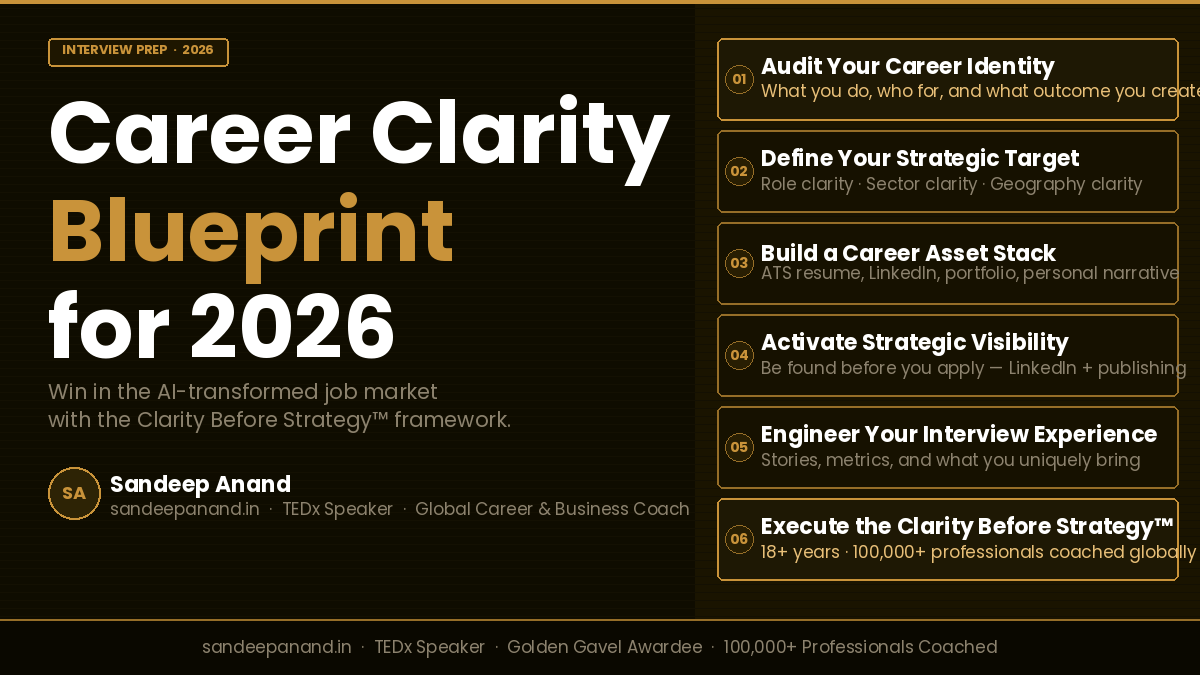
The Clarity Before Strategy™ Framework: 5 Steps for 2026
Step 1 — Audit Your Career Identity
Most professionals cannot answer this question in under 60 seconds: What do I do, who do I do it for, and what outcome do I create?
This is your Career Identity Statement — and it is the anchor of everything that follows. Without it, your LinkedIn profile is vague, your resume is generic, and your interviews feel like you are improvising.
Action: Write your Career Identity Statement in this format:
“I help [specific audience] achieve [specific outcome] through [your unique approach or skill set].”
Step 2 — Define Your Strategic Target
In the 2026 job market, applying to 100 roles and hoping for the best is the fastest route to burnout and rejection. The professionals I coach who get hired within 60 days are ruthlessly specific about their target.
Your strategic target has three dimensions:
- Role clarity: The 2–3 specific roles you are genuinely excellent at and energised by
- Sector clarity: The industries where your experience translates to high value
- Geography clarity: The markets you are targeting — and in a remote-first world, this can be global
Step 3 — Build a Career Asset Stack
Your career asset stack is the collection of materials that work for you 24/7. In 2026, this includes:
- An ATS-optimised resume (test yours for free at our Resume Builder)
- A LinkedIn profile with a keyword-rich headline, a compelling About section, and a strong creator presence
- A portfolio or proof page — especially critical for professionals in tech, marketing, design, consulting, and finance
- A personal narrative you can deliver in 90 seconds in any setting
Step 4 — Activate Strategic Visibility
The 2026 hiring market rewards those who are found, not just those who apply. The most powerful career moves I have seen happen when the right decision-maker encounters your thinking before you ever submit a resume.
How to build strategic visibility:
- Publish 2–3 posts per week on LinkedIn sharing genuine insights from your work
- Engage meaningfully with content from leaders at your target companies
- Speak at virtual or in-person events in your domain
- Contribute to industry publications, podcasts, or newsletters
Step 5 — Engineer Your Interview Experience
Getting the interview is step four. Winning it is step five. In 2026, companies are conducting more structured, competency-based interviews than ever — often across multiple rounds with panel formats.
The professionals who convert interviews at the highest rate are those who have done the deep work of Step 1. They know their stories, they know their impact metrics, and they know what they uniquely bring to the table.
If you want a guided, personalised roadmap through all five steps, book a 1:1 Career Clarity Session with me directly.
Specific Strategies by Career Stage
For Freshers & Early Career (0–3 Years Experience)
The single biggest mistake I see early-career professionals make globally is treating their lack of experience as a disadvantage. It is not. You are not competing on experience — you are competing on potential, energy, and learning velocity.
Your 2026 priority stack:
- Build a portfolio of results, even if from internships, academic projects, or freelance work
- Get AI-literate immediately — complete at least one credible AI or data certification
- Optimise your LinkedIn before you apply anywhere
- Target growing sectors: climate tech, AI infrastructure, healthcare technology, and digital financial services are hiring aggressively worldwide
For Mid-Career Professionals (4–12 Years Experience)
You are at the most powerful and most dangerous stage. Powerful because you have real, demonstrable impact. Dangerous because you may have coasted on industry knowledge that is now being disrupted.
Your 2026 priority stack:
- Reframe your experience around business outcomes, not tasks
- Identify your “super skill” — the intersection of what you do exceptionally well and what the market values most
- Begin building thought leadership content in your domain
- Consider whether you need to make a strategic lateral move to a higher-growth sector
For Senior & Executive Professionals (12+ Years Experience)
At this level, the job market operates entirely differently. Roles are rarely advertised. They are filled through networks, executive search, and reputation.
Your 2026 priority stack:
- Invest in your executive brand — your LinkedIn, your speaking engagements, your media presence
- Cultivate deliberate relationships with 5–7 executive search firms in your domain globally
- Define your board-readiness narrative if you are targeting NED or board positions
- Work with a senior career coach to articulate your unique leadership thesis
For senior executives, I offer a dedicated Executive Career Strategy session tailored to your specific situation.
The Global Job Market in 2026: Where the Opportunities Are
North America: Tech, healthcare AI, and fintech are seeing strong hiring. The return-to-office mandates of 2024–2025 have created significant movement as professionals who do not want to commute daily are actively seeking new roles.
United Kingdom & Europe: Post-Brexit talent pipelines and EU Green Deal investments are creating significant demand in sustainability, infrastructure, and professional services.
Middle East (UAE, Saudi Arabia): Vision 2030 and UAE 2031 are generating extraordinary demand for leaders in tech, construction, finance, and healthcare. English-proficient global professionals are actively recruited.
Asia-Pacific (Singapore, Australia, India): AI-driven sectors, digital government initiatives, and the ASEAN digital economy are creating the highest volume of new roles in the region’s history.
Frequently Asked Questions
Q: How long does it typically take to find a new job in 2026? A: With a clear strategy and optimised assets, most professionals I work with land a new role within 60–90 days. Without clarity, it can take six months or longer.
Q: Is LinkedIn still the most important platform for job seeking? A: Yes, overwhelmingly so. But in 2026, passive presence is not enough. You need an active, content-driven LinkedIn strategy.
Q: How do I compete against AI and automation for jobs? A: By focusing on the skills AI cannot replicate: strategic judgment, emotional intelligence, complex communication, and creative problem-solving. And by becoming AI-literate so you can use AI as a force multiplier.
Q: What is the Clarity Before Strategy™ method? A: It is a coaching framework developed by Sandeep Anand that helps professionals define their unique value, strategic direction, and career positioning before investing in execution. Learn more here.
Ready to take control of your career in 2026? Start with your free ATS Resume Check or book a session with Sandeep directly.