
The job market is going through its biggest change ever. The World Economic Forum predicts 170 million new jobs this decade, but 92 million roles will disappear due to these changes. This means we’ll see a net gain of 78 million jobs. Only 25% of senior executives believe their workforce has the skills needed for tomorrow’s challenges.
A skills revolution is reshaping how we work. Traditional skills become outdated faster than ever before. The average skill now lasts just 6 years, down from 30 years. Companies expect 39% of their core skills will need updates by 2030. Success at work depends on new abilities. Complex problem solving, critical thinking, and creativity top the list of must-have skills for the future.
My research reveals the workplace skills that will matter most in 2026. You’ll learn what employers want but don’t openly discuss. The roadmap ahead shows how to build skills that keep you competitive as jobs change faster than ever.
The biggest changes in workplace skills by 2026
The job market faces massive changes as we approach 2026. Multiple forces now redefine what makes workers valuable. Let’s get into the major changes that shape workplace skills requirements.
Why traditional skills are no longer enough
Traditional models can’t keep up with how fast skills become outdated. Remote work, platform talent, and AI-enabled learning now separate capability from location and tenure. The focus has moved toward proven abilities instead of credentials. About 70% of employers now use skills-based hiring. Many point out that students can prove their value best by sharing real examples of problem-solving with their skills.
Students need hands-on learning during college that connects to professional work. The baseline for competence evolves faster than ever – 13.3% of all jobs and 10.5% of entry-level positions now just need AI skills.
The effect of AI, automation, and green tech
Jobs at entry level with high AI exposure see the biggest drops in demand. To cite an instance, consulting firms cut junior roles while they train AI agents, yet they still hire senior consultants. The question isn’t whether AI will affect the global economy – it’s how fast and deep these changes will go.
The green transition creates promising opportunities. Climate-change adaptation should add 5 million net jobs globally by 2030. Climate-change mitigation will bring 3 million more. “Green hiring” has outperformed overall labor market trends over the last several years. LinkedIn members with green skills find jobs at much higher rates than others.
Jobs that are growing—and those that are disappearing
Healthcare guides job growth and makes up about 65% of the 610,000 jobs added to the U.S. economy through November 2025. Nursing, home health care, and healthcare support roles offer many opportunities as demographic demand rises.
AI adoption triggers restructuring in businesses of all sizes. U.S. employers announced 1.2 million layoffs in 2025 – a 58% increase from the previous year. Technology firms made up 154,445 of these cuts. Companies hire fewer entry-level workers now, and the workforce feels this change at the lowest corporate levels.
Environmental Engineers and Renewable Energy Engineers rank among the top 15 fastest-growing jobs. Customer service roles face uncertainty as AI gets better at understanding callers’ needs.
The 8 essential workplace skills your boss expects
Your boss has specific expectations about skills that combine technical know-how with human abilities as companies look toward 2026. Here are eight workplace skills your employer values most:
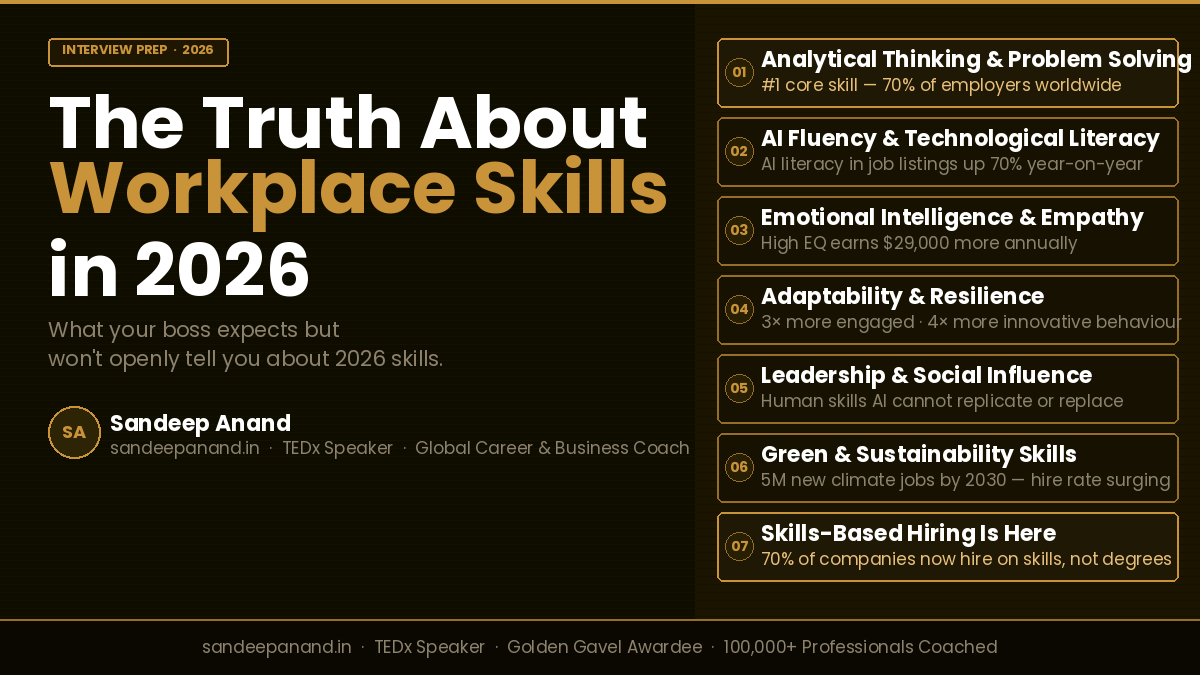
1. Analytical thinking and breakthroughs
Seven out of ten employers worldwide see analytical thinking as a core skill their workforce must have. The World Economic Forum ranks the knowing how to gather information, review data, and make informed decisions at the top of their skills list. Companies value people who can break down complex problems, spot patterns, and create solutions that help businesses succeed.
2. Technological literacy and AI fluency
The skills landscape changes faster than ever, with US jobs needing AI literacy growing 70% year over year. Employers now expect simple AI knowledge in many roles, much like coding or cybersecurity skills. This means understanding how to use AI tools wisely to work better while still relying on human judgment.
3. Emotional intelligence and empathy
A newer study, published by the World Economic Forum shows that emotional intelligence skills rank among the top 10 core competencies alongside analytical thinking. People with high emotional intelligence earn $29,000 more yearly than those who score low. This skill helps you recognize feelings, manage emotions, and build stronger workplace connections.
4. Adaptability and resilience
People who score high in both resilience and adaptability are three times more likely to stay engaged at work. They also show almost four times more innovative behavior. These skills help professionals see change as a chance to grow, handle emotions better, learn from experience, and face uncertainty with creativity.
5. Leadership and social influence
Six out of ten employers value leadership and social influence, making it the third most important skill. Leadership goes beyond management – it inspires others, builds trust, and creates positive change whatever your role. Young professionals can develop influence by connecting with others and motivating them to act.
6. Environmental and sustainability awareness
Half the companies with strong sustainability strategies report better employee retention and engagement, according to Deloitte. US consumers make buying decisions based on a brand’s environmental stance 87% of the time. This growing focus makes sustainability knowledge a vital workplace skill.
7. Creativity and originality
Nearly 60% of employers value creative thinking, ranking it fourth among essential skills. The knowing how to tackle problems from new angles leads to solutions beyond standard approaches. Human creativity becomes more valuable as automation grows, helping organizations adapt and stay competitive.
8. Continuous learning and curiosity
Half of all employees will need new skills by 2025 as technology advances. The ongoing quest for knowledge helps professionals stay current, build future-ready skills, and grow in a technology-driven job market. Companies that focus on developing internal talent are 33% more likely to lead their industry.
What your boss isn’t telling you about upskilling
Employers are quietly raising their skill requirements but aren’t telling anyone about it. You need to take charge of your own professional growth now more than ever.
The hidden expectations behind job descriptions
Job listings use coded language to hide what they really want. Companies that ask for “quick learners” want people who can pick up new technologies on their own. “Strong communication skills” means you should be good at handling conflicts and working across teams, not just writing well.
Why internal training isn’t always enough
Company training programs can’t keep up with what the market wants. About 79% of organizations say upskilling matters, but only 33% feel ready to handle it. The task of staying up-to-date falls on workers themselves. Even companies with strong learning platforms offer training that fits their needs rather than helping employees grow their careers.
How companies are quietly moving hiring priorities
Companies now care more about what you can do than your credentials. About 70% of organizations use or are learning about skills-based hiring. The “hidden job market” fills 80% of positions without public listings. Companies fill these roles based on proven skills before advertising them. This leaves qualified candidates who lack specific skills at a disadvantage.
How to stay ahead in a skills-first economy
Professional development has become essential in our skills-first economy. You must take charge of your career growth. The numbers tell the story – 87% of global companies face or expect skill shortages. Your career path depends on how well you adapt and grow.
Identifying your transferable skills
Core abilities that work across all roles and industries make up your transferable skills. You should look at your typical workday tasks and notice what comes naturally. Problem-solving, time management, and adaptability often go unnoticed but help you switch careers smoothly. Job descriptions for your target roles will show how your current skills match market needs. Professionals who can state these connections clearly have an edge in today’s job market.
Choosing the right upskilling platforms
The best platforms use AI-driven analytics to spot skill gaps accurately. They should also customize content based on how you learn best. Good platforms let you learn from others through feedback and group talks. HR leaders and professionals can benefit from micro-learning – short lessons that fit busy schedules without getting in the way of daily work.
Building a personal learning roadmap
Tools like myIDP or ChemIDP help you get a full picture of where you stand. Your next step is to create SMART goals (Specific, Measurable, Achievable, Relevant, Time-bound) that work. Of course, staying current with industry trends through publications, conferences, and professional networks helps you spot growth opportunities. Regular skill gap checks ensure your growth matches what the market needs.
Leveraging mentorship and peer learning
Experienced professionals can guide you to bridge skill gaps through mentoring. Both sides win – mentees learn practical skills from experts while mentors develop their professional abilities by teaching. Peer learning helps you stay accountable and builds momentum to use new skills at work. Studies show this works – 90% of employees with mentors say they’re happy with their careers.
Conclusion
The workplace of 2026 needs a radical change in career development approaches. Without doubt, traditional skill development paths have broken down. Skills that once lasted 30 years now barely survive 6 years. We must adapt quickly instead of just reacting to changes.
Companies now value proven skills more than credentials. Yet many struggle to tell workers what they really want. Skills-based hiring, AI requirements, and the green economy bring new hurdles and chances for smart professionals. Strong evidence shows that automation might eliminate some jobs. Still, it creates just need for human traits like creativity, empathy, and analytical thinking.
You now carry the main burden of growing professionally. While employers support ongoing learning, their training often falls behind what markets want. Your success depends on finding transferable skills and picking the right learning platforms. You need a custom learning plan and good mentors.
Smart professionals who welcome this skills-first mindset stay ahead of their rivals. People who adapt fast and show mastery of both technical and human skills will succeed whatever industry changes come. This skills revolution is a chance to stand out by growing deliberately rather than collecting certificates.
Tomorrow belongs to people who know workplace skills are not fixed assets. They are living abilities that need constant work. Your success depends on how well you spot changes coming, build new skills, and use them well. This shapes not just your job prospects but the future of work itself.

![17 High-Income Skills That Pay $100K+ in 2026 [Expert List]](https://www.sandeepanand.in/wp-content/uploads/2026/03/preview_34_17-high-income-skills-300x169.png)