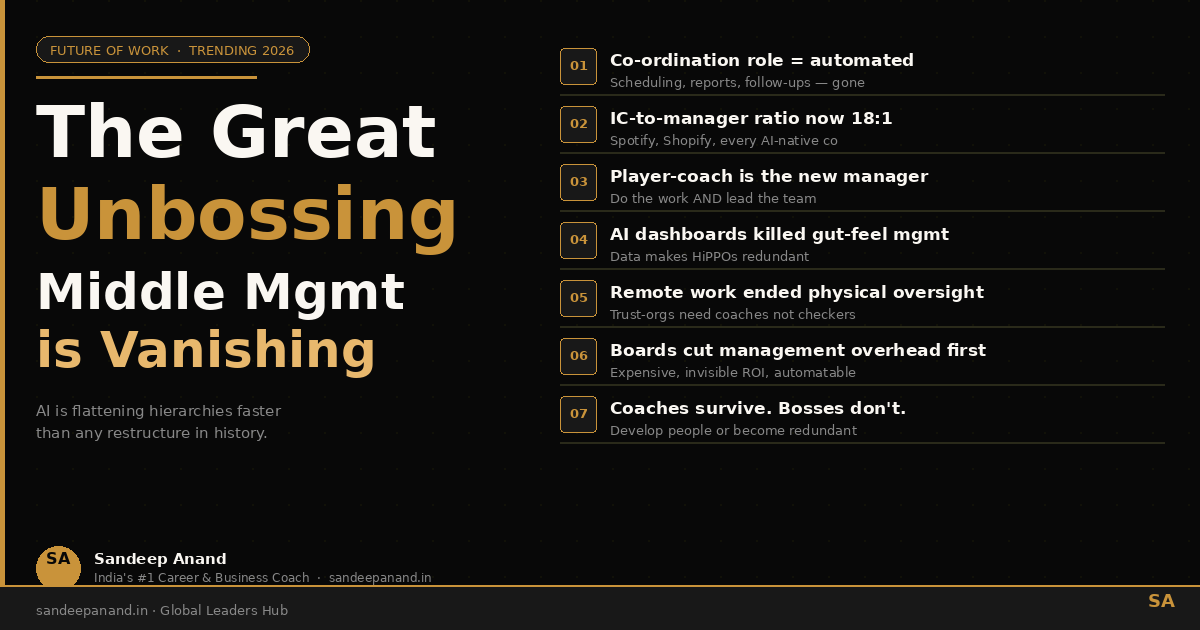
The Great
Unbossing
Why Middle Management
is Vanishing
AI is not coming for the people doing the work. It is coming for the layer of people who organised, reported on, and co-ordinated the people doing the work. That layer is called middle management. And it is shrinking faster than most organisations are willing to admit.
There is a new term circulating in HR circles, strategy consulting decks, and leadership forums: the Great Unbossing. It describes the systematic compression of middle management layers accelerating since 2024 — driven not just by economic pressure, but by something more structural: AI can now do what managers were primarily hired to do.
Co-ordination. Status reporting. Information relay. Routine decision arbitration. Progress tracking. These are not peripheral management tasks. They are management, for a significant portion of the management population.
AI Replaced the Co-ordinator Role
The co-ordinator function — scheduling, status-checking, follow-up emails, progress dashboards, meeting minutes — was always the most automatable part of management. Tools like Motion, Asana AI, Monday.com AI, and Slack’s AI workflow builder now handle all of this without human intervention.
A project that in 2022 required a dedicated project co-ordinator can now be managed by the AI layer of a project management tool, with a senior individual contributor spending two hours per week on oversight.
IC-to-Executive Ratio Is Shrinking Fast
For decades, the standard IC-to-manager ratio in knowledge work hovered around 6:1 to 8:1. Companies like Spotify, Shopify, and most AI-native companies are now operating at 12:1 to 18:1 — or eliminating the middle layer entirely.
The logic is simple: when AI handles co-ordination, information flow, and routine decision-making, each senior leader can effectively oversee a broader team. Fewer layers means faster decisions and dramatically lower management overhead costs.
The Player-Coach Is the New Manager
The management model replacing traditional middle management is the player-coach: a leader who does substantive individual work while also developing and enabling a team. Companies adopting this model report faster decision-making, higher individual contributor satisfaction, and significantly leaner cost structures.
The player-coach who is both technically sharp and capable of developing others is one of the most valuable profiles in the 2026 talent market.
The manager who only manages is already an endangered species. The manager who also builds is the most in-demand professional in the market.
— Sandeep Anand, Global Leaders HubData Killed the Gut-Feel Manager
One of the traditional justifications for management layers was experience-based judgement — the senior manager who could read a situation and make a call based on pattern recognition the ICs didn’t yet possess. AI dashboards and real-time analytics have transferred a significant portion of that pattern recognition to machines.
When every team member has a live dashboard showing project health, velocity, risk indicators, and customer signals, the manager whose primary contribution was ‘knowing what was happening’ becomes redundant.
Remote Work Removed the Oversight Rationale
A substantial portion of middle management’s perceived value was physical proximity: the manager who walked the floor, noticed who was struggling, caught problems before they escalated. Remote and hybrid work — now permanent in most knowledge work environments — removed this rationale entirely.
When oversight cannot be physical, it becomes data-driven. And when it is data-driven, it becomes automatable.
Boards Are Targeting Management Overhead First
When boards and CFOs scrutinise headcount, management layers offer the most attractive cost reduction opportunity: they are expensive (mid-to-senior compensation), their output is often invisible on customer-facing metrics, and their function is increasingly automated.
The 2024–2026 wave of restructuring announcements at Meta, Salesforce, Amazon, and dozens of others disproportionately targeted management layers — not front-line execution. This is not a temporary correction.
What Survives: Coaches, Not Bosses
The management function that AI cannot replicate is human development — the ability to see potential in a person, to name it, to challenge it, to create the conditions for someone to become better than they were. No dashboard tracks this. No algorithm grows a person’s confidence, expands their thinking, or helps them navigate the genuinely hard moments of a career.
The managers who will compound in the next decade are those who have built their identity around developing people, not overseeing processes.
How to Adapt — Before the Restructure Reaches You
- ▸Audit your current role: identify what percentage of your week is co-ordination/reporting vs. genuine judgement and human development.
- ▸Develop deep domain expertise: player-coaches are valued because they are also individually excellent.
- ▸Become the best AI user on your team: managers who adopt AI tools earliest appear more capable, not less necessary.
- ▸Build your coaching identity deliberately: develop a reputation for growing people. Make their career trajectories your most visible output.
- ▸Build lateral influence: the flat organisation rewards those with broad trust networks, not positional authority.
Navigating a Leadership Transition?
Whether you are a manager adapting to the flat organisation or an executive building one — I help leaders redesign their value proposition for the AI era.
Book an Executive Consultation Explore CoursesSandeep Anand
India’s #1 Career & Business Coach · TEDx Speaker · Golden Gavel Awardee
Founder of Global Leaders Hub. Coach to 100,000+ professionals globally. Career strategy, executive coaching, and AI-readiness. Based in Hyderabad.