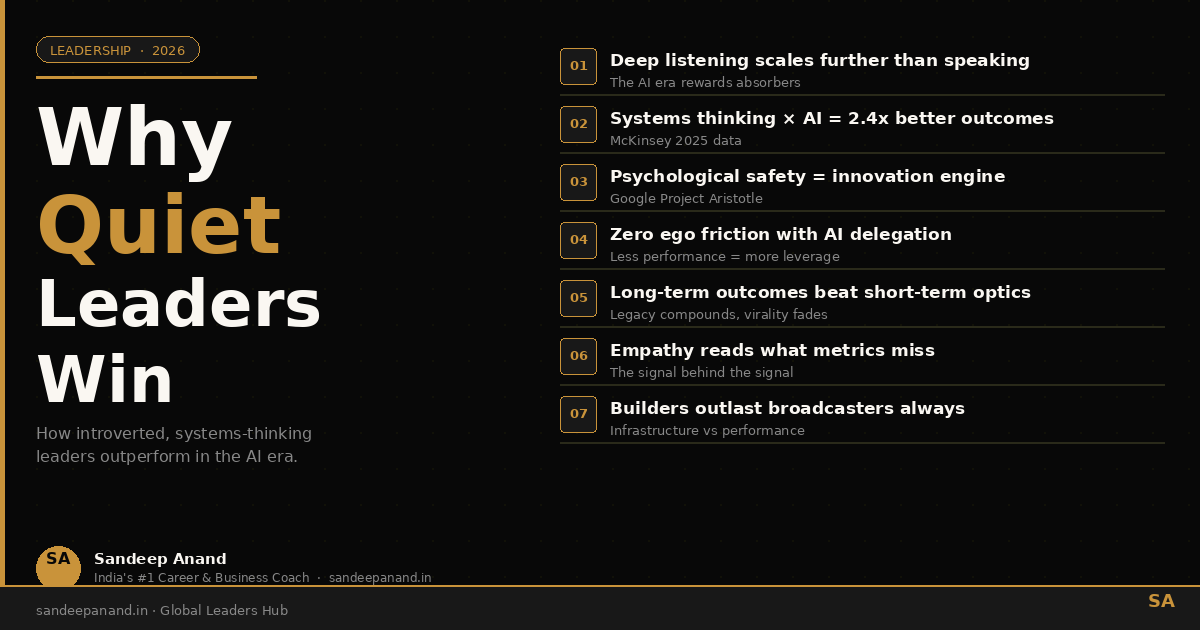
Why Quiet Leaders
Win in the Age of AI
The loudest voice in the room is no longer the most powerful one. In an era where AI handles the broadcast, the leader who listens best holds the ultimate advantage.
We spent decades rewarding the loudest person in the boardroom. The one with the most confident take, the sharpest slide deck, the biggest personal brand. And for a long time, that worked — because information was scarce and the person who could synthesise and broadcast it held power.
That era is ending. In 2026, AI handles research, synthesis, summarisation, and communication at scale. The premium is no longer on who can broadcast — it is on who can listen, build trust, and make high-context decisions. That is the quiet leader’s natural territory.
They Listen Before They Lead
Quiet leaders absorb fully before responding. In an AI-augmented environment where the information landscape shifts daily, this is a strategic advantage, not a soft skill.
Teams led by deep listeners surface problems earlier, share ideas more freely, and avoid executing on the wrong signal. Google’s Project Aristotle identified psychological safety — the belief that you can speak without punishment — as the single biggest predictor of team performance. Quiet leaders build it instinctively.
Systems Thinking Scales Further with AI
Quiet leaders think in systems: they map dependencies, anticipate second-order effects, and design processes rather than react to incidents. This cognitive style is precisely what AI amplifies.
Research from McKinsey’s 2025 leadership survey found that executives who demonstrated systems thinking integrated AI into their decision-making 2.4× faster than peers — and reported 31% better outcomes on complex projects.
Psychological Safety Is Their Competitive Edge
In high-AI environments, the teams that win are the ones that experiment most rapidly — because AI lowers the cost of experimentation to nearly zero. But experimentation requires psychological safety: people must feel they can try, fail, and share what they learned without career risk.
Quiet leaders create this environment naturally. They do not dominate discussions. They credit others. They ask genuine questions rather than performing authority.
The leader who creates the conditions for others to think is worth more than the leader who thinks loudest.
— Sandeep Anand, Global Leaders HubThey Delegate to AI Without Ego Friction
One of the most under-discussed barriers to AI adoption is ego. Leaders who have built their identity around being the ‘smartest person in the room’ struggle to cede cognitive territory to a machine. Quiet leaders — who were never performing intellectual dominance — have no such friction.
They delegate research, drafting, summarisation, and scheduling to AI naturally, freeing themselves for the work that demands genuine human judgement: trust-building, strategic ambiguity, people development, and ethical navigation.
Long-Term Orientation Beats Short-Term Optics
Loud leadership often optimises for visibility: the impressive all-hands, the viral LinkedIn post, the bold public prediction. Quiet leadership optimises for outcomes: team capability, process quality, and compounding trust. In a high-uncertainty, high-AI environment, outcomes are the only currency that survives.
Empathy Is Their Data Layer
AI is extraordinarily good at quantitative signals: engagement metrics, performance data, output rates. What it cannot yet read is the unspoken — the team member who seems productive but is burning out, the meeting dynamic that signals a trust breakdown, the hesitation in a voice that means disagreement has gone underground.
Quiet leaders read these signals because they are watching, not performing.
They Build, Not Broadcast
In an AI world where every executive can now generate a thought-leadership post in minutes, the signal value of broadcast collapses. What cannot be automated is what endures: the team you developed, the process you designed, the culture you protected.
Legacy, not virality. Infrastructure, not performance. Quiet leaders were always optimising for the right thing — the world has just caught up with them.
If You Are a Quiet Leader — Here Is the Gap to Close
Your challenge is not to become someone else. It is to make your strengths visible. Quiet leaders often underinvest in the one area where loud leaders have an edge: strategic self-advocacy.
- ▸Document your outcomes, not just your effort. Make the work attributable.
- ▸Develop executive presence on your terms — credible, calm, and clear at moments that matter.
- ▸Build your AI fluency deliberately. Your systems thinking is the perfect complement to AI.
- ▸Find a sponsor, not just a mentor. Someone who speaks for you in rooms you are not in is worth ten times a mentor who affirms you.
Ready to Lead Deliberately?
I work with professionals and executives to build leadership strategies that compound. Whether you are a quiet leader looking to increase your impact or a loud one learning to slow down — let’s design your next chapter.
Book a Consultation Explore CoursesSandeep Anand
India’s #1 Career & Business Coach · TEDx Speaker · Golden Gavel Awardee
Founder of Global Leaders Hub. Coach to 100,000+ professionals globally. Career strategy, executive coaching, and AI-readiness. Based in Hyderabad.