A 2023 LinkedIn survey found that only 37% of Indian professionals negotiate salary when receiving a job offer. The number who proactively ask for an internal salary raise is even lower. This is not because Indian professionals are paid fairly — a 2025 foundit survey found 47% are not satisfied with their salary growth. It is because the cultural norm in Indian workplaces is to wait for the organisation to recognise and reward performance, rather than to actively request the market correction that is warranted.
The result is predictable. The typical Indian professional waits for the annual appraisal cycle, receives a 10–12% increment, accepts it without discussion, and watches the external market pull further away from their compensation each year. Meanwhile, the external market for their skills is offering 30–50% more to someone with an equivalent profile who has the confidence to apply. Sandeep Anand at Global Leaders Hub coaches professionals through this exact gap using the CBS™ (Clarity Before Strategy™) framework.
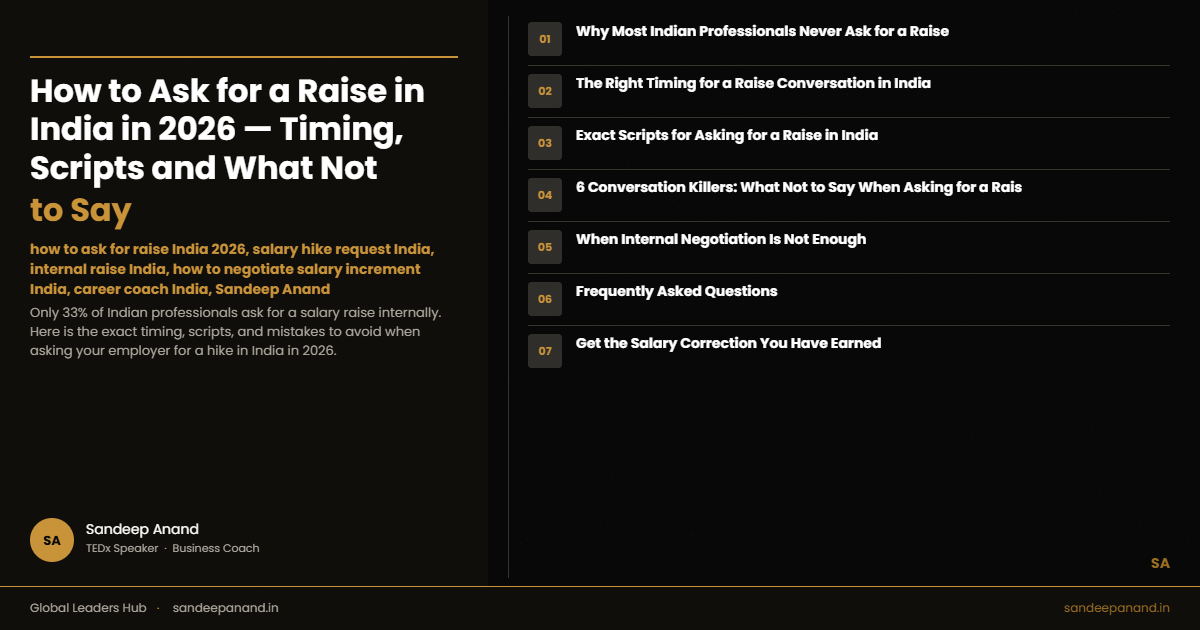
Why Most Indian Professionals Never Ask for a Raise
The reasons most Indian professionals do not ask for an internal raise are cultural and psychological rather than strategic. In India’s corporate hierarchy, salary discussions with management are often perceived as presumptuous, uncomfortable, or even disloyal. The cultural expectation is that good performance is recognised automatically — and that asking for more suggests dissatisfaction that might upset the relationship or signal disloyalty.
Fear of Seeming Greedy
The Indian professional culture equates salary negotiation with greed rather than professional advocacy. This norm is not universal — it is cultural conditioning that systematically costs Indian professionals lakhs over their careers.
Waiting for Recognition
Most Indian professionals wait for their organisation to recognise and reward them appropriately. This passive approach is systematically exploited by compensation structures that reward those who ask and retain the inertia of those who don’t.
No Benchmark Data
You cannot negotiate effectively without data. The 14% of Indian professionals who remain unaware of salary benchmarks in their own field are the most likely to accept whatever they are offered — without knowing whether it is fair.
“Asking for a raise is not demanding. It is professional advocacy backed by data. The organisation that does not reward that clarity is telling you something important about its relationship with you — and the answer to that is not to stop asking, but to expand where you are looking.”
The Right Timing for a Raise Conversation in India
Timing is often the difference between a successful raise conversation and a disappointing one. The highest-leverage windows:
- 1
4–6 weeks before the appraisal cycle starts. This is the most important window. Once calibration meetings have happened and increment percentages are finalised, they are extremely difficult to revise. Before calibration, your manager can still advocate for a higher rating and increment. After calibration, they cannot. If you do not know when your company’s appraisal cycle begins, find out — this is the single most important piece of information for an internal raise strategy.
- 2
Immediately after a significant delivery. Post-project momentum is real. In the 1–2 weeks after delivering a major project, launching a product, or solving a significant problem, you have earned the right to a compensation conversation. Your recent achievement is your evidence, your leverage, and your timing justification simultaneously.
- 3
After being given expanded responsibilities without a salary revision. Being asked to take on additional scope without additional compensation is a common practice in Indian IT services. It is also a moment of leverage — you have already demonstrated willingness and capability for the higher role. The ask at this point is simply aligning your compensation with your actual contribution.
- 4
When you have a genuine competing offer. A real external offer from a named company at a specific number is the most powerful raise lever available. Use it honestly and professionally — not as a threat but as a market data point that reflects your current value.
Exact Scripts for Asking for a Raise in India
Requesting a meeting to discuss compensation
“I would like to schedule 30 minutes with you to discuss my compensation. I have been preparing some market benchmarking data and I want to share my perspective on where I am relative to the market and what I am targeting. When would suit you in the next two weeks?”
Opening the raise conversation
“I have been in this role for [X] years and I am proud of what I have contributed — specifically [one or two specific achievements with measurable outcomes]. I have done some benchmarking against AmbitionBox and LinkedIn Salary data for my role, level, and city, and I am currently about [X%] below market median. I am targeting a revision to [specific number] LPA. Is that something we can work toward in the upcoming cycle?”
When your manager says it is not possible this cycle
“I understand the cycle constraints. Can we agree on a specific out-of-cycle revision in [month], tied to [specific deliverable or milestone]? I would like to document what we are working toward so we are aligned. Would you be willing to put that in writing after this conversation?”
6 Conversation Killers: What Not to Say When Asking for a Raise in India
- 1
“I have a home loan / family commitments.” Personal financial need is irrelevant to your employer’s compensation decision. It generates sympathy, not salary increases. Your ask must be grounded in your professional value and market data, not your personal circumstances.
- 2
“I might have to look outside” (without a real offer). Empty threats damage your credibility and your relationship without producing any result. If you have a genuine offer, use it. If you do not, do not imply that you do.
- 3
“I have been working really hard.” Effort is the expectation, not the differentiator. Quantified results, market benchmarks, and expanded contributions are the inputs to a raise conversation — not hours worked or dedication expressed.
- 4
“My colleague earns more than me.” Salary comparison with a specific colleague is both professionally inappropriate and likely inaccurate. Market benchmarks are objective and defensible; individual comparisons are not.
- 5
Asking by email without a conversation. Email raise requests in India are almost universally declined or ignored. The conversation — in person or on video — is where relationships, tone, and real negotiation happen. Email is for confirmation, not initiation.
- 6
Accepting a vague timeline without a specific commitment. “We will look at this in the next cycle” without a specific month, a specific amount, and ideally a written record is a polite deferral, not a commitment. Always close the conversation with a specific next step or document.
When Internal Negotiation Is Not Enough
If your internal raise target is 30%+ above your current compensation — which is common for professionals who have stayed at the same company for 3+ years while the external market moved — it is extremely unlikely to be achieved through internal negotiation alone. Indian companies have compensation bands, and asking someone to skip multiple bands internally is very rarely approved regardless of how well you ask.
In this situation, the correct strategic move is an external job search with the explicit goal of a market correction, not continued internal negotiation that cannot reach your target. A 30–50% external premium is routinely achievable for strong profiles at GCCs, product companies, and well-funded startups in India in 2026. For a structured plan that determines whether internal negotiation or an external move is right for your specific situation, a Career Guidance Session with Sandeep Anand at Global Leaders Hub provides CBS™-backed analysis. Explore courses and resources for self-paced support.
Frequently Asked Questions
Get the Salary Correction You Have Earned
Book a Career Guidance Session with Sandeep Anand and walk into your next raise conversation with CBS™-backed data, scripts, and a clear ask.
Book Career Guidance Session →
Also explore: Hired 2.0 Course · All Coaching Services · Free Priority DM