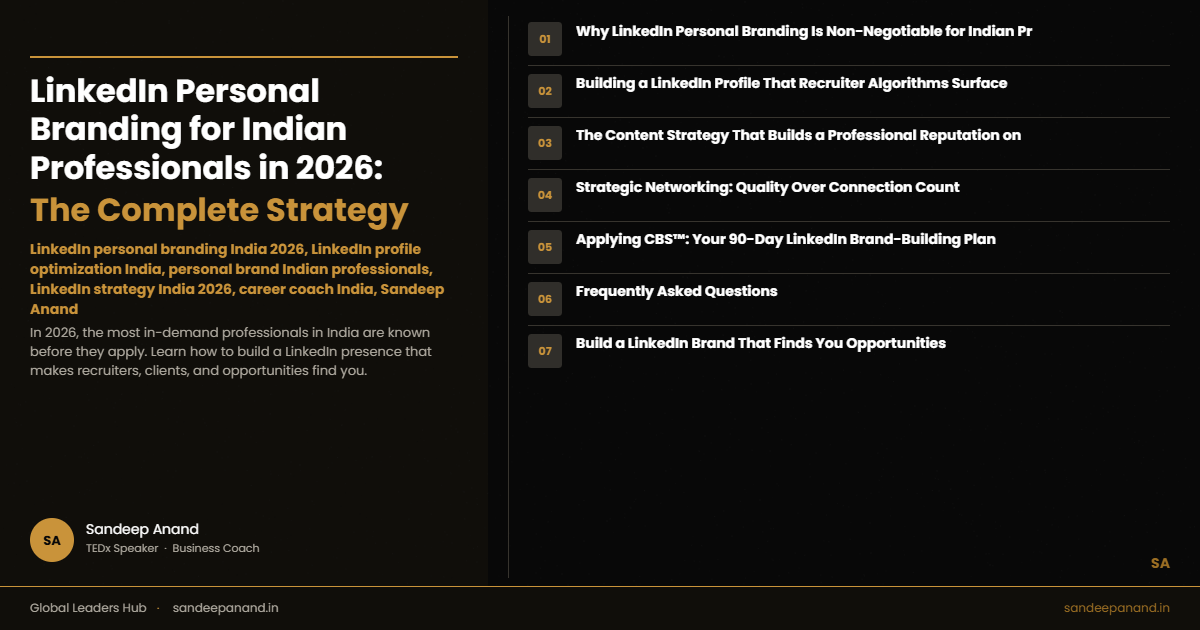
- Why LinkedIn Personal Branding Is Non-Negotiable in 2026
- Building a LinkedIn Profile That Recruiter Algorithms Surface
- The Content Strategy That Builds a Professional Reputation
- Strategic Networking: Quality Over Connection Count
- Applying CBS™: Your 90-Day LinkedIn Brand-Building Plan
- Frequently Asked Questions
There is a fact about India’s 2026 job market that most professionals either do not know or are not acting on: the professionals who command the highest salaries, receive the most inbound recruiter interest, and negotiate from the strongest position are not necessarily the most experienced professionals in their field. They are the most visible. Not visible in a self-promotional, performative sense — but visible in a way that allows people to assess their thinking, their values, and their capability before ever speaking to them.
This is a structural shift in how professional credibility is signalled in India’s knowledge economy, and Sandeep Anand identified it early. At Global Leaders Hub, where 100,000+ professionals across 32 countries have been coached, the data from the last three years is unambiguous: professionals who invest in their LinkedIn brand are finding roles 40–60% faster, commanding salary negotiations from a position of strength, and building careers that are resilient to market disruptions in ways that invisible professionals simply cannot.
Why LinkedIn Personal Branding Is Non-Negotiable for Indian Professionals in 2026
The 2026 business trends analysis from Sandeep Anand’s own research, informed by coaching professionals at companies including TCS, Infosys, Wipro, Cognizant, Amazon, Microsoft, and Google across India, USA, and the UK, reveals a consistent pattern: the transition from an outsourcing economy to a product-building economy is changing what professional credibility looks like.
In an outsourcing economy, credibility was institutional — your company’s name on your resume was your credential. In a product-building economy, credibility is individual — what you know, how you think, what you have built, and what others say about you are your credentials. LinkedIn is where this individual credibility is built and maintained at scale. And in 2026, AI-powered recruiter sourcing has made this more consequential, not less. GCC talent acquisition teams and product company recruiters are finding candidates through algorithmic LinkedIn search before a single job posting is published.
AI-Powered Sourcing
GCC and product company recruiters in 2026 use LinkedIn Recruiter with AI filters to find candidates algorithmically. A well-optimised profile surfaces in recruiter searches that a poorly structured one never appears in — regardless of experience.
Inbound Opportunity Generation
Professionals who publish consistently on LinkedIn generate inbound recruiter messages, speaking invitations, consulting enquiries, and business referrals — opportunities that are not available to professionals who are invisible on the platform.
Negotiation Leverage
When a recruiter or company finds you, you negotiate differently than when you apply to them. Inbound interest creates leverage. A strong LinkedIn brand builds the inbound channel that transforms your negotiation position.
“Your LinkedIn profile is not your digital resume. It is your professional reputation made searchable. In 2026, every Indian professional who wants to be in control of their career trajectory needs to understand this distinction — and build accordingly.”
Building a LinkedIn Profile That Recruiter Algorithms Surface
LinkedIn’s algorithm surfaces profiles based on keyword relevance, profile completeness, engagement signals, and connection proximity to the searcher. Understanding these factors and deliberately optimising for them is not gaming the system — it is ensuring that the quality of your experience and thinking is actually discoverable by the people who need to find it.
The five profile elements that most determine whether Indian professionals appear in recruiter searches in 2026:
- 1
Headline: Describe value created, not your job title. Your headline is the most powerful real estate on your LinkedIn profile from an algorithm perspective, and most Indian professionals waste it with their current job title and company. “Senior Software Engineer at TCS” tells a recruiter nothing they cannot infer. “Cloud Migration Architect | AWS Certified | Helping enterprises move to scalable cloud infrastructure” immediately communicates your specialisation, your credentials, and the problem you solve. The keyword-rich headline is how you appear in searches. The value proposition is how you capture attention once you do.
- 2
About section: Tell your professional story with specific outcomes. Write in first person. Begin with your professional identity and what you specifically do, not with your educational background. Include two to three specific outcomes from your career that demonstrate the quality of your work. End with a clear statement of who you want to connect with and why. Most Indian professionals either leave the About section blank or fill it with a dense, passive-voice job description. Both approaches are opportunities missed.
- 3
Experience entries: Lead with impact, follow with activity. Each experience entry should open with the business context and your key outcome, then describe the activities and responsibilities that produced that outcome. “Led the migration of 200+ enterprise clients to AWS, reducing client infrastructure costs by 35% on average” is a profile-opening experience bullet. “Responsible for managing cloud infrastructure projects” is invisible. The impact-first structure is both more compelling to human readers and more keyword-rich for algorithm performance.
- 4
Skills section: Optimise for the language your target recruiters search. LinkedIn’s skill endorsements contribute to your search relevance. The skills you list should reflect the specific terminology used in the job descriptions of roles you target — not just the language your current organisation uses internally. There is often a significant gap between these two vocabularies, particularly for professionals moving from IT services to GCC or product company roles.
- 5
Featured section: Curate your best proof of expertise. Use the Featured section to showcase your two or three strongest proof points — a LinkedIn post that performed well, a project summary, a presentation, an article you wrote, or a significant achievement. This section converts a recruiter who finds you through search into someone who actively wants to reach out. It is the difference between a profile that is found and one that is acted on.
The Content Strategy That Builds a Professional Reputation on LinkedIn
Profile optimisation gets you found. Content is what builds your reputation once you are there. In 2026, the Indian professionals who are growing their LinkedIn presence most effectively are not the ones posting daily motivational quotes or sharing news articles with one-sentence captions. They are the ones who are publishing specific, experience-based perspectives on their domain — consistently, over time.
The content framework that Sandeep Anand coaches through the LinkedIn & Personal Branding Mastery session at Global Leaders Hub:
| Content Type | Frequency | What It Builds |
|---|---|---|
| Domain insight from your experience | Weekly | Expertise credibility and recruiter visibility |
| Industry trend analysis with your perspective | Bi-weekly | Strategic thinking reputation and thought leadership |
| Career lessons and professional story | Monthly | Personal brand distinctiveness and relatability |
| Client / project outcomes (anonymised) | Monthly | Proof of impact and problem-solving capability |
| Engagement on others’ posts | 3–5x per week | Network expansion and algorithm visibility boost |
The most common question Sandeep Anand receives from Indian professionals at companies like Infosys, Wipro, Cognizant, and Amazon when building their LinkedIn presence is: “What can I write about that is genuinely interesting?” The answer is always the same: write about the specific problems you solve, the decisions you make, and the patterns you observe — from your own professional experience. No one else has your specific vantage point. That specificity is what makes content valuable. Generic content can be produced by anyone. Specific, experience-based content cannot be replicated.
The Content Mistakes Indian Professionals Make Most Often
Understanding what not to do is as important as knowing what to do. The content approaches that actively damage professional brand on LinkedIn in India in 2026:
- 1
Generic motivational posts with no professional substance. “Success requires hard work and discipline” posts are noise in a professional’s feed. They communicate nothing about your domain expertise, your thinking quality, or your professional identity. Over time, a feed full of these posts makes you invisible even to people who follow you — the algorithm deprioritises content with low engagement, and generic motivation generates minimal genuine engagement.
- 2
Sharing news without adding your perspective. Sharing a news article about AI in banking with no comment, or a one-sentence “interesting read” caption, adds no value to your professional network. Add your specific perspective — what this means for your domain, what you would do differently, what the implications are for the professionals in your industry. That perspective is your brand.
- 3
Posting only when job-hunting. The professionals who receive inbound recruiter interest consistently are those who build their presence over months and years — not those who post intensively for two weeks when they are between jobs. LinkedIn brand building is a marathon, not a sprint. Start now, regardless of whether you are currently job-hunting.
Strategic Networking: Quality Over Connection Count
One of the most persistent misconceptions about LinkedIn among Indian professionals is that connection count is a meaningful metric of professional brand strength. It is not. A professional with 2,000 highly engaged, strategically selected connections in their target industry and seniority level will consistently outperform one with 12,000 random connections from a decade of clicking “connect” on every suggested profile.
Strategic LinkedIn networking for Indian professionals in 2026 means building connections with deliberate intent — not volume:
- 1
Connect with purpose, not habit. Every connection request should have a clear rationale — this person is at a company I want to join; this person is a domain expert whose perspectives I learn from; this person is a potential collaborator or referral source. Personalise every connection message with one specific reason you want to connect. Generic “I’d like to add you to my professional network” messages are ignored at high rates by the senior professionals you most want to reach.
- 2
Engage before connecting. Comment thoughtfully on the posts of professionals you want to connect with before sending a connection request. One or two genuine, substantive comments makes your connection request recognisable — and accepted at dramatically higher rates than a cold request from someone who has never engaged with their content.
- 3
Build inside your target companies. For professionals targeting GCC roles, product companies, or specific industries in India, USA, or the UK, deliberately build connections inside those organisations. Employees at target companies, not HR teams, are your most valuable network nodes. A referral from an existing employee at a GCC typically fast-tracks your application past the AI screening stage entirely.
Applying CBS™: Your 90-Day LinkedIn Brand-Building Plan
The CBS™ (Clarity Before Strategy™) approach to LinkedIn brand building starts with the same question it starts every career strategy conversation with: what outcome are you building toward? The answer shapes everything — your headline, your content themes, your network strategy, and how you measure success.
The CBS™ 90-Day LinkedIn Brand Plan
Days 1–30: Profile Foundation. Complete a full profile audit. Rewrite your headline, About section, and top three experience entries using the impact-first framework. Set up your Featured section with two proof points. Activate ‘Open to Work’ in recruiter-only mode if applicable. This foundational work ensures every subsequent piece of content has a high-quality destination to send people to.
Days 31–60: Content Consistency. Publish two pieces of domain-specific content per week. Engage thoughtfully on five to eight posts per day in your target industry community. Send ten strategic connection requests per week with personalised messages. Track which content formats (text, carousel, short video) generate the most genuine engagement from your target audience.
Days 61–90: Visibility Amplification. Identify your top-performing content themes and double down on them. Request skill endorsements from colleagues who can genuinely speak to your specific expertise. Publish one longer-form article on a domain topic that demonstrates deep expertise. Measure inbound connection requests, recruiter messages, and profile view growth as your primary success metrics.
This 90-day framework is the starting point. LinkedIn brand building is a compounding investment — the professionals who have been publishing consistently for 12–24 months have profiles and reputations that are simply not comparable to those who started last month. The best time to start is always now.
For personalised coaching on your specific LinkedIn profile, content strategy, and network-building approach, Sandeep Anand’s LinkedIn & Personal Branding Mastery session provides a structured, outcome-focused approach that has helped professionals at companies across India, the USA, and the UK build professional reputations that generate consistent inbound career opportunities. Explore additional free resources at Global Leaders Hub to begin building your brand today.
Frequently Asked Questions
Build a LinkedIn Brand That Finds You Opportunities
Book a LinkedIn & Personal Branding Mastery session with Sandeep Anand — and leave with a complete, personalised profile and content strategy built for India’s 2026 market.
Book LinkedIn Mastery Session →
Also explore:
Career Guidance Session ·
Free Resources ·
Free Priority DM