There is a pattern Sandeep Anand has observed across 100,000+ professionals coached at Global Leaders Hub in Hyderabad, India, and across 32 countries: the professionals who are most consistently passed over for senior leadership promotion are not the low performers. They are the high performers who are delivering excellent work, managing their teams responsibly, and meeting every KPI — but are invisible to the decision-makers who control the next level.
If you are a Senior Manager, Associate Director, or similar mid-to-senior level professional at TCS, Infosys, Amazon, Google, Microsoft, or any GCC or Indian company — and you have been in your current band for two or more performance cycles without promotion — this article is for you. The problem is almost certainly not your performance. It is your positioning, your presence, and your strategy. And those are fixable with the right framework.
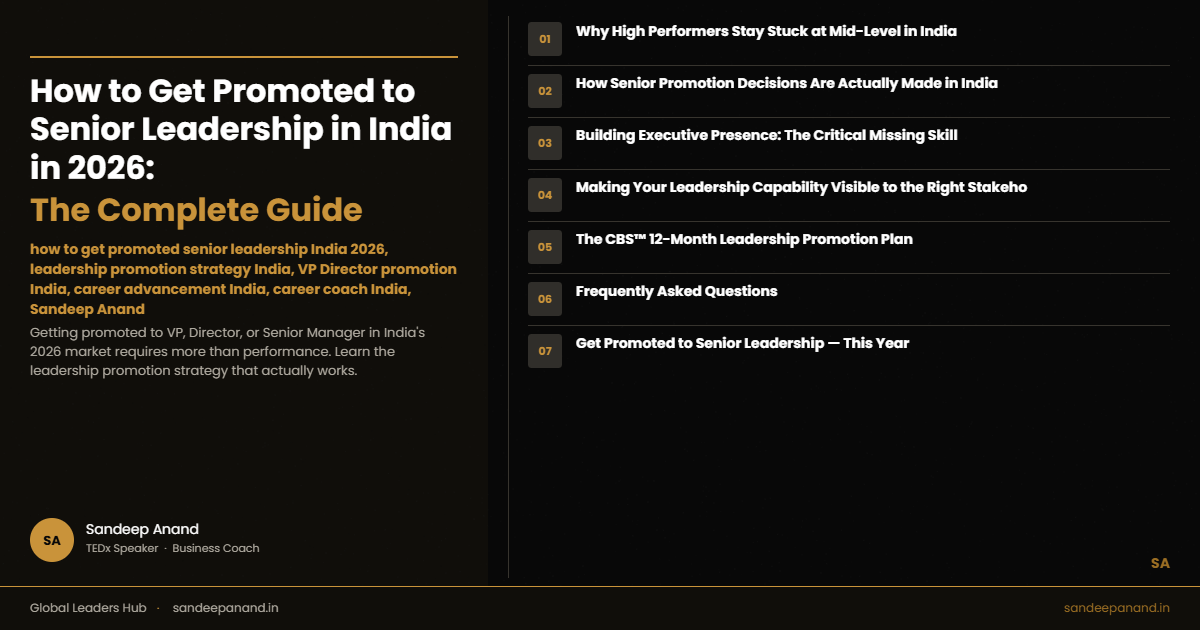
Why High Performers Stay Stuck at Mid-Level in India
The transition from mid-level to senior leadership is the most difficult and least understood career transition in India’s corporate ecosystem. Every professional understands broadly how to get from junior to mid-level: perform well, get recognised, get promoted. The formula is reasonably linear. The formula for mid-to-senior is fundamentally different — and most professionals do not realise this until they have been stuck for several years.
The core problem is what Sandeep Anand calls the execution trap. Mid-level professionals who are excellent executors — reliable, thorough, technically strong — get rewarded for execution. They get praised, given more responsibilities, and trusted with bigger deliveries. But senior leadership roles are not execution roles. They are influence, strategy, and direction-setting roles. And execution excellence, while necessary, does not signal readiness for those roles to the decision-makers who control promotion at the top.
The Execution Trap
Delivering excellent results in your current role signals you are good at your current role — not necessarily that you are ready for the next one. Senior promotions require demonstrating the next level’s capabilities before being given that level’s title.
The Visibility Problem
Many high performers are invisible to the senior leaders who make promotion decisions. If your work is not regularly visible to the right people, you are not on their mental shortlist when opportunities arise — regardless of how well you deliver.
The Presence Gap
Executive presence is not about being loud or extroverted. It is about projecting clarity, confidence, and strategic thinking in high-stakes moments. Most mid-level professionals have never been coached on this specific dimension.
“In every organisation I have worked with across India, the USA, and the UK, the professionals most consistently passed over for senior leadership are not the weakest — they are the ones who are waiting to be noticed. Senior leadership does not find you. You have to make yourself findable, at the right level.”
How Senior Promotion Decisions Are Actually Made in India
Understanding the mechanics of how senior promotions are decided at Indian companies and GCCs is essential before building your strategy around them. The official process — performance ratings, calibration meetings, HR approval — is the visible part of the process. The actual decision is made well before any of that, in informal conversations among senior leaders.
At Director level and above in most large organisations in India, promotion decisions are made through a process called calibration — where senior leaders discuss their top talent across functions. The question they are asking is not “who performed best?” — that data is in the rating system. The question they are asking is “who is ready to lead at the next level? Who do I trust with greater scope? Who has demonstrated senior leadership judgment?” If your name is not in those conversations — either because no senior leader knows you well enough to advocate for you, or because your reputation is as an excellent executor rather than an emerging leader — you will not be promoted regardless of your performance rating.
| What You Think Matters | What Actually Gets You Promoted |
|---|---|
| High performance rating every cycle | Senior leader advocacy in calibration conversations |
| Delivering all your KPIs | Demonstrating next-level judgment and scope |
| Tenure and loyalty to the organisation | Visible impact on business outcomes |
| Being liked by your direct team | Being trusted by leaders two levels above you |
| Technical or domain expertise | Strategic thinking communicated clearly to senior stakeholders |
| Avoiding political situations | Navigating organisational dynamics with maturity |
This does not mean performance does not matter — it is the necessary baseline. But in 2026’s India corporate environment, where budgets for leadership positions are tighter due to restructuring and AI-driven efficiency mandates, the bar for promotion has risen significantly. The professionals getting promoted to Director and VP level at companies across Bengaluru, Hyderabad, and Pune are those who have built relationships with senior sponsors, demonstrated leadership judgment in high-visibility situations, and shaped how senior management thinks of them — not just performed well in their immediate role.
Building Executive Presence: The Critical Missing Skill
Executive presence is the capability that most consistently differentiates professionals who get promoted to senior leadership from those who do not. It is also the capability that is least explicitly taught, least commonly coached, and most frequently misunderstood in India’s corporate context.
Executive presence is not about being the loudest person in the room. It is not about being aggressive, politically savvy in a manipulative sense, or self-promotional. In India’s corporate culture — where deference to seniority is deeply embedded and self-advocacy is often uncomfortable — executive presence requires a specific set of behaviours that feel counterintuitive to many high-performing professionals.
- 1
Communicate outcomes, not activities. When you update senior stakeholders, do you say “we completed the migration on schedule” or “we completed the migration, which reduces our operational risk by 30% and frees up capacity for the Q3 product launch”? The second framing demonstrates strategic thinking. The first demonstrates task completion. Senior leaders consistently promote professionals who frame their work in business-outcome terms.
- 2
Own ambiguity without escalating it. Senior leaders have limited bandwidth. A mid-level professional who consistently brings problems to their manager for resolution is signalling that they need supervision. A professional ready for senior leadership brings options, makes a recommendation, and asks for approval — not direction. This shift in how you handle uncertainty is one of the most visible signals of leadership readiness.
- 3
Speak with confidence in senior forums — even when you are the junior-most person in the room. Many Indian professionals remain silent in leadership meetings unless directly addressed, out of deference or uncertainty. This silence is interpreted as disengagement or lack of strategic thinking — not respect. Speaking with a clear, well-reasoned perspective, even occasionally, is far better than consistent silence. Sandeep Anand’s coaching at Global Leaders Hub, drawing on his experience as a TEDx Speaker and Golden Gavel Awardee, specifically develops this communication capability.
- 4
Handle conflict and difficult conversations with maturity. Senior leaders observe how you handle disagreement, pushback, and interpersonal friction. Professionals who avoid difficult conversations or become defensive under challenge are not promoted into roles where those situations are daily occurrences. Developing the skill to disagree respectfully, hold your position with data, and resolve conflict without damaging relationships is essential at this level.
Making Your Leadership Capability Visible to the Right Stakeholders
The most underutilised promotion lever in India’s corporate ecosystem is deliberate visibility management. This is not about self-promotion in a way that feels uncomfortable or culturally inappropriate. It is about ensuring that the work you do — and the thinking behind it — is visible to the stakeholders who control promotion decisions.
Visibility strategy for senior leadership promotion in India includes:
- 1
Volunteer for cross-functional, high-visibility projects. These projects bring you into contact with senior leaders outside your direct reporting line. They allow you to demonstrate leadership capability in a context where your direct manager is not the only observer. One cross-functional project where you perform with distinction is worth more for your promotion case than two years of excellent performance in your existing role.
- 2
Present your team’s work at leadership forums. If you manage a team, find opportunities to present their work — and your strategic thinking behind it — directly to senior leadership. Every such presentation is an audition. Prepare it as one. The quality of your presentation, the clarity of your strategic framing, and how you handle questions from senior leaders shapes how they think of you for future opportunities.
- 3
Build relationships with sponsors two levels above you. A sponsor is different from a mentor. A mentor gives you advice. A sponsor advocates for you in rooms you are not in. Deliberately build two or three genuine working relationships with leaders two levels above your current role. This means finding ways to contribute to their priorities — not just your manager’s — and giving them direct exposure to your thinking and capability.
- 4
Build an external professional brand on LinkedIn. In 2026, your visibility is not limited to your office walls. Senior leaders and HR business partners at your company, and at companies you might move to, are observing your LinkedIn presence. Publishing data-driven, thoughtful perspectives on your domain — even two posts per month — significantly increases your professional visibility and reputation. For a structured approach, explore LinkedIn & Personal Branding Mastery with Sandeep Anand.
The CBS™ 12-Month Leadership Promotion Plan
Sandeep Anand’s Clarity Before Strategy™ (CBS™) methodology provides the structured framework for turning the strategies above into a specific, time-bound promotion plan. Across 100,000+ professionals coached at Global Leaders Hub, the professionals who achieve senior leadership promotion consistently do so through a deliberate 12-month plan — not through waiting, hoping, and working hard in their existing role.
The CBS™ 12-Month Leadership Promotion Framework
Months 1–3: Clarity. Diagnose exactly why you have not been promoted yet — is it visibility, presence, executive relationships, or skill gaps? What specific behaviours and capabilities does the next level require in your organisation? Get direct feedback from your manager and at least one sponsor or mentor outside your team. This diagnosis is the foundation of your entire plan.
Months 4–6: Build and demonstrate. Identify one to two specific high-visibility opportunities to demonstrate next-level leadership capability. Volunteer for cross-functional work. Improve your stakeholder communication. Begin building or deepening relationships with senior sponsors. Publish your expertise externally.
Months 7–9: Make your case visible. Your manager should be aware of your promotion intent — not through a single awkward conversation, but through ongoing evidence of next-level behaviour. Request a development conversation where you explicitly discuss what is required for the next promotion cycle. Address any specific gaps your manager or skip-level identifies.
Months 10–12: Position for the cycle. Ensure your advocate network is active and aware that you are ready for the next level. Prepare specific examples of senior leadership behaviour for your performance review and any promotion committee discussions your manager must have. Your goal is to make the yes decision easy for the people who control it.
For professionals who want to accelerate this process with structured coaching, Sandeep Anand’s Leadership Development and Promotion Pathway session at Global Leaders Hub is a 60-minute coaching engagement that produces a personalised CBS™-driven promotion plan — specific to your organisation, your current level, and your target role. Explore our free career consultation as a first step if you want to understand what your specific promotion gaps are before booking a full session.
Frequently Asked Questions
Get Promoted to Senior Leadership — This Year
Book a 60-minute Leadership Development and Promotion Pathway session with Sandeep Anand and leave with your personalised CBS™ promotion plan.
Book Leadership Development Session →
Also explore:
Leadership Interview Blueprint ·
Free Consultation ·
Free Priority DM