The two most common reasons Indian professionals contact Global Leaders Hub for coaching are not dramatic career crises — they are quieter forms of suffering: exhaustion that does not resolve with rest, and a flat, grey disengagement that makes every workday feel identical to the last. Both present similarly on the surface. Both use the same vocabulary: “I am tired,” “I do not feel motivated,” “I need a change.” But they have opposite root causes and require completely different interventions.
Getting the diagnosis wrong is costly. Taking a 2-week holiday when you are bored does not fix boredom — you return to the same flatness. Changing careers when you are burned out does not fix burnout — you carry the depletion into the new role and burn out there too, faster. Sandeep Anand at Global Leaders Hub coaches Indian professionals through this exact distinction using the CBS™ (Clarity Before Strategy™) framework across coaching engagements in India, the USA, and the UK. A Naukri survey found that 74% of Indian professionals hesitate to discuss mental health concerns at work — which means most professionals are navigating this diagnosis alone, without the structured support that would make the right intervention obvious.
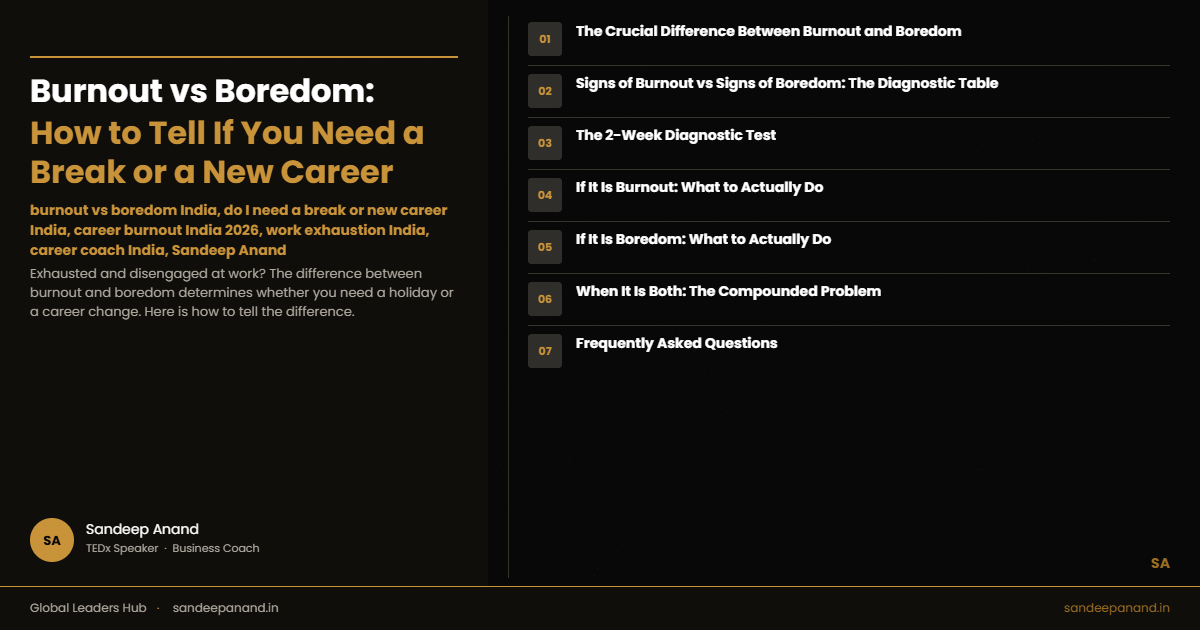
The Crucial Difference Between Burnout and Boredom
Burnout: Caused by Overload
Burnout is the result of sustained, unrecovered demand: too much work, too much emotional pressure, too little control, and chronically insufficient recovery. The nervous system reaches a depletion state where even tasks that were previously energising now feel impossible. Burnout is caused by the quantity and intensity of what is demanded of you.
Boredom: Caused by Underload
Boredom is the result of under-stimulation: too little challenge, too little growth, too little meaning in the work itself. The nervous system is not depleted — it is underwhelmed. Boredom is caused by the quality and alignment of what the work offers you, not by how much it demands.
Signs of Burnout vs Signs of Boredom: The Diagnostic Table
| Symptom | Points to Burnout | Points to Boredom |
|---|---|---|
| Energy level | Profound exhaustion, even after sleep | Flat, not tired — more like apathy |
| Emotional state | Anxiety, cynicism, irritability, emotional numbness | Indifference, mild restlessness, quiet dissatisfaction |
| Response to time off | Relief, some recovery, but dread returns before work resumes | Same flatness returns immediately when work resumes |
| Work quality | Declining — capacity is genuinely reduced | Maintained or high — you can do it, you just do not care |
| What you envy | People who seem less stressed, have more balance | People in different roles or industries entirely |
| Physical symptoms | Frequent headaches, sleep disruption, lowered immunity | Generally fine physically, but mentally disengaged |
“Burnout says: I cannot keep going at this pace. Boredom says: I do not want to keep going in this direction. They sound similar but they are pointing in completely different directions — and the map you need to follow them is different.”
The 2-Week Diagnostic Test
The most reliable initial diagnostic is a genuine 2-week break from work — complete disconnection, no email, no work-related thinking. After this break, evaluate your internal state honestly:
- 1
If your energy has returned and you feel capable but the thought of returning to this specific work creates dread — you likely experienced burnout caused by pace and overload. The work itself may not be wrong; the conditions in which you do it are.
- 2
If your energy has returned but you feel the same flatness about returning to work that you felt when you left — the problem is not the pace, it is the work itself. This is boredom signalling misalignment.
- 3
If your energy has not returned even after a genuine break — your burnout may be severe enough to require professional mental health support before any career decisions are made. Please speak with a qualified mental health professional.
If It Is Burnout: What to Actually Do
Genuine burnout recovery requires three things that are often in short supply in Indian professional culture: rest that is not just physical (it must include cognitive and emotional disengagement from work), structural changes to the conditions that produced the burnout (recovery without structural change is a reset that will reproduce the same outcome), and the professional support to navigate the conversation with your employer about those changes.
What burnout does not require: a new career, a dramatic resignation, or a completely different life. The CBS™ framework applied to burnout recovery starts by assessing whether the role itself is wrong or whether the conditions of the role are wrong — because the interventions differ significantly. A Work-Life Balance and Career Satisfaction session with Sandeep Anand at Global Leaders Hub addresses exactly this distinction.
If It Is Boredom: What to Actually Do
Boredom that persists across project changes, team changes, and management changes is signalling a structural misalignment — you are in the wrong role, function, or domain for your actual capabilities, values, and growth needs. The intervention is not a holiday, more coffee, or a productivity system. It is a structured process of clarity-building about where your energy, skills, and values actually point — followed by a deliberate transition plan toward a role that can provide the stimulation and growth your current one cannot.
This is the work that the CBS™ framework is specifically designed for. The Career Pivot Strategy session at Global Leaders Hub applies the CBS™ framework to professionals experiencing boredom-driven career stagnation — building the clarity and the plan that converts dissatisfaction into intentional movement. Explore free consultation options as a first step.
When It Is Both: The Compounded Problem
Many Indian professionals experience both simultaneously: they are burned out by the pace and conditions of a role they are also bored by. This compounded state is the most debilitating — too depleted to look for something better, too disengaged to perform at the level that would make their current role more rewarding. The CBS™ approach to this state addresses recovery first and career strategy second — because clarity requires a nervous system with enough capacity to generate it. The sequencing matters enormously.
If this compounded state resonates with your experience, the Work-Life Balance and Career Satisfaction session at Global Leaders Hub is specifically designed for it — addressing both the immediate recovery needs and the longer-term career realignment that prevents recurrence.
Frequently Asked Questions
Get the Diagnosis Right — Then Get Moving
Book a Work-Life Balance and Career Satisfaction session with Sandeep Anand — and leave knowing whether you need a break, a pivot, or both.
Book Work-Life Balance Session →
Also explore: Life Coach Discovery · Free Consultation · Free Priority DM