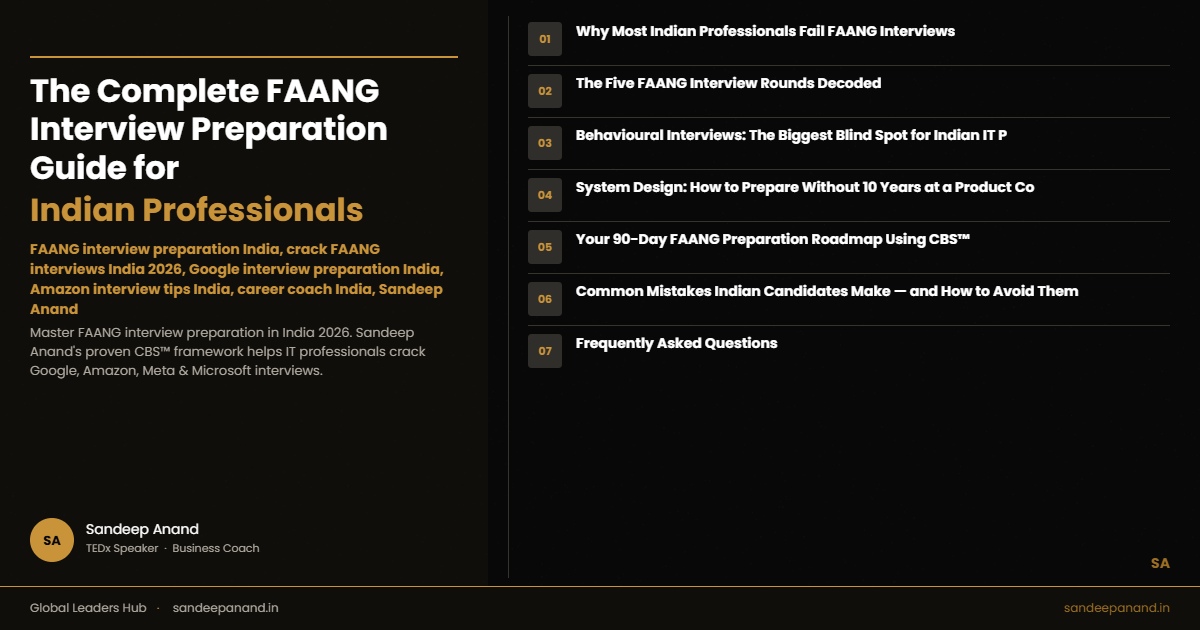
- Why most Indian professionals fail FAANG interviews
- The five FAANG interview rounds decoded
- Behavioural interviews: the biggest blind spot for Indian IT professionals
- System design: how to prepare without 10 years at a product company
- Your 90-day FAANG preparation roadmap using CBS™
- Common mistakes Indian candidates make — and how to avoid them
- Frequently asked questions
Every year, thousands of Indian software engineers, product managers, and business analysts send applications to Google, Amazon, Meta, Apple, and Microsoft. A fraction get a recruiter call. Fewer still make it past the first technical screen. And a significant number of those who reach the final rounds — professionals who are genuinely talented, with strong resumes and years of experience — go home without an offer.
The reason is almost never that they lacked the technical ability. It is that they prepared for the wrong parts of the interview, in the wrong order, with no clear picture of where their actual gaps were.
Having coached over 100,000 professionals across India, USA, and the UK at Global Leaders Hub, Sandeep Anand has seen this pattern repeat at companies like TCS, Infosys, Wipro, Cognizant, Flipkart, and beyond. The professionals who crack FAANG interviews are not always the most technically gifted — they are the ones who prepare with Clarity Before Strategy™ (CBS™): understanding precisely what they need to work on before they open a single LeetCode problem.
This guide breaks down the full FAANG preparation process for Indian professionals in 2026 — from understanding the interview structure to building your behavioural story bank, from system design preparation to the final negotiation conversation you will need to be ready for.
Why Most Indian Professionals Fail FAANG Interviews
The failure points are consistent enough that they can be mapped. After coaching hundreds of Indian professionals through FAANG preparation — including engineers and PMs at TCS, Infosys, Wipro, HCL, Cognizant, and mid-tier product companies in Hyderabad, Bengaluru, Pune, and Delhi — the same cluster of gaps appears again and again.
- 1
Over-indexing on Data Structures and Algorithms (DSA). Indian engineering culture places enormous emphasis on competitive programming. While DSA proficiency is necessary, most candidates at the 5+ years of experience level fail not in the coding round but in system design or behavioural rounds. Spending 90% of preparation time on LeetCode while leaving two entire interview stages under-prepared is a structural error.
- 2
Underestimating the behavioural interview. FAANG companies — and Amazon in particular — use structured behavioural interviews as primary filters for seniority. The “Bar Raiser” interview at Amazon exists specifically to evaluate leadership behaviours. Indian candidates from service companies often have no framework for articulating their decision-making, their ownership mindset, or their impact in measurable terms.
- 3
Weak narrative positioning from service-company backgrounds. A professional who has spent six years at TCS or Infosys on client-managed projects can have strong underlying capability but describe their work in a way that sounds passive and process-driven. FAANG interviewers are looking for evidence of agency, ownership, and independent thinking — and the framing matters as much as the facts.
- 4
No level or role calibration. Applying to Google as an L4 when your experience maps to L5 — or targeting the wrong role type entirely — means you will be filtered out before a single interviewer sees your work. Most candidates skip the research step of understanding what level they are applying for and what the evaluation rubric is at that level.
- 5
Preparing in isolation without feedback. Solving LeetCode problems alone and reading system design books in silence does not replicate the conditions of a real FAANG interview. Interviews are a performance — they require verbal fluency under pressure, the ability to think out loud, and the skill to ask good clarifying questions. These are learnable but only through practice with feedback.
Understanding which of these gaps is your primary constraint is the starting point of the CBS™ approach — Clarity Before Strategy. Before building a preparation schedule, you need a diagnostic picture of where you actually stand.
The Five FAANG Interview Rounds Decoded
The specific interview process varies by company and role. However, the core structure is consistent enough that preparing for the following five stages will equip you for any FAANG or FAANG-adjacent company interview. This applies to software engineering, product management, and senior individual contributor roles.
Recruiter Screen (30 minutes)
A phone or video call to confirm basic eligibility — role fit, location, visa status, and high-level experience. This is not a technical evaluation, but it is your first impression. Prepare a crisp 90-second career summary and know what level and team you are targeting. Having a vague answer here signals poor self-awareness.
Online Assessment or Phone Screen (60–90 minutes)
For engineering roles, this is typically 1–2 LeetCode-style coding problems under time pressure. For PM roles, it may be a product case question via email or a short take-home. At this stage, speed and correctness are evaluated together. Medium-difficulty problems with clean, well-explained code matter more than solving hard problems inefficiently.
Technical Interview Loops (3–5 rounds, 45–60 minutes each)
The main technical evaluation — typically including coding, system design, and a technical deep-dive on past projects. For senior roles (L5+ at Google, SDE-II+ at Amazon), system design carries significant weight. For PM roles, product design and analytical thinking rounds replace or accompany technical rounds.
Behavioural / Leadership Round (45–60 minutes)
The most underestimated stage. At Amazon, the “Bar Raiser” conducts this round independently and holds veto power. At Google, this is often woven into multiple rounds. Questions target specific past behaviours: “Tell me about a time you disagreed with your manager”, “Describe a situation where you owned a failure”. You need pre-prepared, rehearsed STAR stories — not ad-hoc recollection.
Hiring Committee Review and Offer
Feedback from all interviewers is compiled and reviewed by a hiring committee (HC). At Google and Meta, the HC independently reviews your packet — interviewers do not make the final decision. A strong overall signal with one mediocre round can still result in a hire. Knowing this changes how you approach partial setbacks during an interview loop.
| Company | Total Rounds | Behavioural Weight | System Design | Key Differentiator |
|---|---|---|---|---|
| 4–5 onsite + screen | Medium–High | 1–2 rounds (L5+) | Googleyness round; clarity of thinking | |
| Amazon | 5–7 including Bar Raiser | Very High | 1 round (SDE-II+) | 16 Leadership Principles evaluated throughout |
| Meta | 4–5 onsite | Medium | 1–2 rounds (E5+) | Cross-functional impact; data-driven decisions |
| Microsoft | 4–5 onsite | Medium | 1 round | Growth mindset; collaboration scenarios |
| Apple | 5–8 (longer process) | Medium | 1 round | Domain depth; ownership narrative |
Behavioural Interviews: The Biggest Blind Spot for Indian IT Professionals
In over a decade of coaching professionals at Global Leaders Hub, Sandeep Anand has identified the behavioural interview as the single most consistent failure point for Indian candidates preparing for FAANG roles — particularly those transitioning from service companies or from engineering backgrounds into senior individual contributor or management tracks.
The root issue is not that Indian professionals lack leadership experience. It is that they have been trained to describe their work in collective, process-oriented language: “Our team delivered the project”, “We followed the Agile methodology”, “The stakeholders approved the requirements.” FAANG interviewers are listening for a completely different signal — individual ownership, clear decision-making authority, and the ability to drive outcomes through others without positional authority.
“In CBS™ coaching, we call this the Ownership Gap. The experience exists — the professional just hasn’t been trained to articulate it in the language FAANG interviewers are using. Reframing the same experience through the right lens can transform a rejected candidate into a hire.”
Building Your STAR Story Bank
The STAR method (Situation, Task, Action, Result) is the standard structure for behavioural answers. But most candidates prepare only 3–4 generic stories and try to stretch them across all questions. This is not sufficient for a senior-level FAANG interview, where interviewers probe deeply with follow-up questions and can quickly identify a rehearsed answer that doesn’t match the specifics they asked for.
A well-prepared candidate should have 8–12 distinct STAR stories, each based on real experiences, each with specific metrics, and each designed to flex across multiple Amazon Leadership Principles or Google behavioural themes. Here is how to categorise them:
Ownership & Bias for Action
A time you took on a problem outside your scope without being asked. Emphasise what was at stake and the outcome you personally drove.
Deep Dive & Data Decisions
A situation where you went deeper than required to uncover a root cause or used data to challenge an assumption or a decision others were comfortable with.
Disagree and Commit
A time you pushed back on a decision from someone more senior, provided your rationale, and then committed to the final direction — whether yours or theirs — with full effort.
Failure and Recovery
A genuine failure story with honest attribution of your role. Interviewers are evaluating self-awareness and learning agility — not a polished “weakness that is actually a strength.”
Influencing Without Authority
How you aligned stakeholders, cross-functional teams, or senior leaders on a direction where you had no direct authority. Especially important for PM and senior IC roles.
Customer Obsession
A decision you made where you chose the right outcome for the customer or end user even when it was inconvenient or costly for your team or business unit.
The Leadership Interview Blueprint from Global Leaders Hub provides a structured workbook for mapping your career history to these categories, with sentence starters, metric framing templates, and example stories from real FAANG interview coaching sessions.
System Design: How to Prepare Without 10 Years at a Product Company
System design is evaluated for senior roles at all FAANG companies — typically from L5/SDE-II upward for engineering and E5+ for product management. This is the second most common failure point for Indian candidates, particularly those whose background has been in service-company delivery or in single-layer application development.
The good news: system design is a learnable skill with a finite set of core concepts. The challenge is that it is evaluated not just on whether you know the concepts, but on how you structure your thinking, communicate trade-offs, and respond to scope changes in real time.
Core Concepts Every Candidate Must Know
CDN & Caching
SQL vs NoSQL
Sharding & Partitioning
Message Queues (Kafka, SQS)
Rate Limiting
CAP Theorem
Microservices vs Monolith
API Design (REST, GraphQL)
Consistent Hashing
Search Systems
Distributed Transactions
Beyond conceptual knowledge, system design interviews reward a specific approach to problem framing. Interviewers want to see that you start with requirements clarification (not jumping straight into architecture), that you estimate scale before choosing technologies, and that you articulate trade-offs explicitly rather than presenting a single “correct” answer as if it were obvious.
The Framework That Works
- 1
Clarify requirements (5 minutes). Before drawing anything, ask what you need to know. Functional requirements (what the system does), non-functional requirements (scale, latency, availability), and what is explicitly out of scope for this design session.
- 2
Back-of-envelope estimation (3 minutes). Calculate approximate QPS (queries per second), storage requirements, and read/write ratio. These numbers drive every subsequent technology decision. Candidates who skip this step make arbitrary technology choices they cannot defend.
- 3
High-level design (10 minutes). Draw the major components — clients, APIs, services, databases, caches. Keep it simple. Communicate as you draw. This is where your verbal fluency matters as much as the diagram.
- 4
Deep dive into one or two components (15 minutes). Let the interviewer guide which component to explore. Show depth on database schema, caching strategy, or fault tolerance — wherever your background is strongest.
- 5
Discuss trade-offs and handle follow-ups (remaining time). Every design decision has trade-offs. Saying “I chose PostgreSQL here because of strong consistency requirements, though at very high write load we would consider a NoSQL option” demonstrates the senior-level thinking FAANG interviewers are evaluating for.
Common mistake: Indian candidates who have studied system design books often present answers that sound memorised — using the exact vocabulary from a single source without being able to adapt the design to new constraints introduced mid-interview. Interviewers recognise this immediately. Preparation must include mock interviews with real-time constraint changes, not just reading and watching videos.
Your 90-Day FAANG Preparation Roadmap Using CBS™
The CBS™ (Clarity Before Strategy) framework, developed by Sandeep Anand at Global Leaders Hub, structures any preparation plan around a diagnostic first step: before deciding what to work on, establish where you are relative to where you need to be. In FAANG preparation, this means auditing your current state across all five evaluation dimensions before building a schedule.
Below is a 90-day structure that works for most Indian IT professionals with 4–10 years of experience targeting L4–L6 engineering or senior PM roles. Adjust the timeline based on your starting point and the results of your initial diagnostic.
Phase 0: The CBS™ FAANG Diagnostic (Week 0 — before you start)
Rate yourself honestly from 1–5 on each dimension: Coding proficiency (Medium/Hard LeetCode), System design fluency, Behavioural story depth, Role and level targeting clarity, Communication and verbal fluency under pressure.
Any dimension rated 1 or 2 becomes a primary focus area. Dimensions rated 4–5 need maintenance only. This single step prevents the most common error: treating all preparation areas as equal priorities.
Days 1–30: Foundations and Story Building
Coding: Solve 2 LeetCode problems per day — one Easy and one Medium. Focus on arrays, strings, linked lists, trees, and hashmaps. Track patterns rather than memorising individual solutions. At this stage, pattern recognition matters more than problem count.
Behavioural: Draft your first 6 STAR stories using the story categories from Section 3. Write them in full, not as bullet points. Measurable outcomes are non-negotiable — “improved performance by 40%” is far more credible than “significantly improved performance.”
System design: Read one foundational resource cover-to-cover. Study two real-world case studies (design Twitter’s feed, design a URL shortener). Do not jump into complex systems before understanding the core primitives.
Days 31–60: Depth and Mock Practice
Coding: Move to Medium and Hard problems. Begin timed practice sessions — 45 minutes per problem. Add two-pointer, sliding window, dynamic programming, and graph traversal patterns.
Behavioural: Conduct your first mock behavioural interviews with someone who can give direct, critical feedback. Record yourself answering questions on video. Watch the recording — most candidates discover they speak too fast, avoid eye contact, or bury the most important part of the story.
System design: Practice designing complete systems out loud — explain every decision as if your interviewer can only hear you, not see your diagram. Aim for three full system design mock sessions with feedback in this phase.
Days 61–90: Interview Simulation and Calibration
This phase is entirely about full simulation under realistic conditions. Schedule at least four mock interviews that replicate the full loop format. Focus on weaker areas identified in Phase 0. This is also when to review your interview preparation approach holistically — are you spending time proportionally to your actual gap areas?
Use your last two weeks to address any single specific weak point identified through mock interviews. Broad preparation at this stage is less valuable than targeted drilling on a known gap.
| Phase | Weeks | Coding Focus | Behavioural Focus | System Design Focus |
|---|---|---|---|---|
| Foundations | 1–4 | Easy + Medium; core patterns | Draft 6 STAR stories with metrics | Core concepts; 2 case studies |
| Depth | 5–8 | Medium + Hard; timed practice | 3 mock behavioural interviews | 3 mock system design sessions |
| Simulation | 9–12 | Full loops; weak-area drilling | Full loop mocks; refine stories | Full loops; trade-off articulation |
Common Mistakes Indian Candidates Make — and How to Avoid Them
Beyond the structural preparation gaps covered above, there are a set of specific, avoidable mistakes that consistently distinguish candidates who receive offers from those who do not. Based on coaching professionals from across India — Hyderabad, Bengaluru, Chennai, Mumbai, Pune, and Delhi NCR — at Global Leaders Hub, these are the patterns that appear most frequently.
- 1
Treating the recruiter as an obstacle rather than an ally. The recruiter who reaches out to you has a strong interest in your success — their job performance is measured partly by offer acceptance rates. Ask them directly: “What level are you evaluating this role at? What are the primary focus areas for the interview loop?” Most recruiters will give useful guidance. Candidates who treat recruiter calls as hurdles to clear miss critical information.
- 2
Refusing to ask clarifying questions in coding rounds. Many Indian candidates, shaped by competitive programming culture, jump directly into writing code when a problem is presented. FAANG interviewers deliberately present ambiguous problems to evaluate whether you ask clarifying questions. Spending 3–5 minutes on requirements clarification is not a weakness — it is a signal of engineering maturity.
- 3
Using company names as credentials instead of impact evidence. “I worked at TCS for 5 years” carries no weight in a FAANG behavioural interview. “I led a team that reduced deployment time by 65% for a 2-million-user financial services application” carries significant weight. Reframe every credential in terms of scope, decision authority, and measurable outcome — not tenure or employer name.
- 4
Not researching the specific team or role. Saying “I’m interested in joining Google” signals a lack of genuine interest. Saying “I’m targeting the Google Ads infrastructure team because of the intersection of distributed systems and auction design” signals preparation and genuine engagement with the domain. Research the team’s engineering blog, recent papers, or product launches before every interview.
- 5
Accepting the first offer without negotiation. FAANG offers — including base salary, RSU grants, and signing bonuses — are negotiable. Most first offers are not the maximum the company can offer. Having a competing offer (real or pending) significantly increases your leverage. Professionals coached by Sandeep Anand at Global Leaders Hub routinely negotiate 15–30% above initial offer values by understanding the offer components and making a structured counter-proposal.
If you are currently in active FAANG preparation, a structured review of your approach against these failure patterns is one of the highest-leverage activities you can do right now. The career consultation page at Global Leaders Hub outlines how a focused session can accelerate your preparation by identifying your specific constraint — not just reviewing generic advice.
“The professionals who crack FAANG aren’t the ones who grind the hardest. They are the ones who know exactly what the gap is between where they are and where the interviewer’s bar sits — and close that specific gap with precision. That is what CBS™ does.”
Sandeep Anand — TEDx Speaker, Golden Gavel Awardee, and Founder of Global Leaders Hub — has guided professionals from TCS, Infosys, Wipro, Cognizant, Flipkart, Swiggy, and a wide range of product companies across India, USA, and UK through this process. With 100,000+ professionals coached across 32 countries and a 5.0★ Trustpilot rating across 331 verified reviews, the CBS™ methodology is the most field-tested approach to FAANG preparation currently available to Indian professionals.
Frequently Asked Questions
Get Your FAANG Offer With Precision Preparation
The Leadership Interview Blueprint gives you the exact story frameworks, metric templates, and behavioural answer structures that separate FAANG hires from rejections. Built by Sandeep Anand after coaching hundreds of professionals through Google, Amazon, Meta, and Microsoft interview loops.
Get the Leadership Interview Blueprint →
Also explore:
Leadership Interview Blueprint (direct) ·
Career Guidance Session ·
All Coaching Services ·
Free Priority DM