The fear that drives most career switch hesitation in India is not fear of failure — it is fear of erasure. The worry that a decade of hard-earned experience will be made irrelevant the moment you step into a new domain. That you’ll be starting over, competing with 22-year-olds for entry-level opportunities.
That fear is understandable. It is also, in almost every case, unfounded.
Experience does not disappear when you change careers — it transforms. The question is not whether your experience is transferable. It is how to reframe it so the new domain recognises and values what you bring. That is exactly what a structured career transition process does.
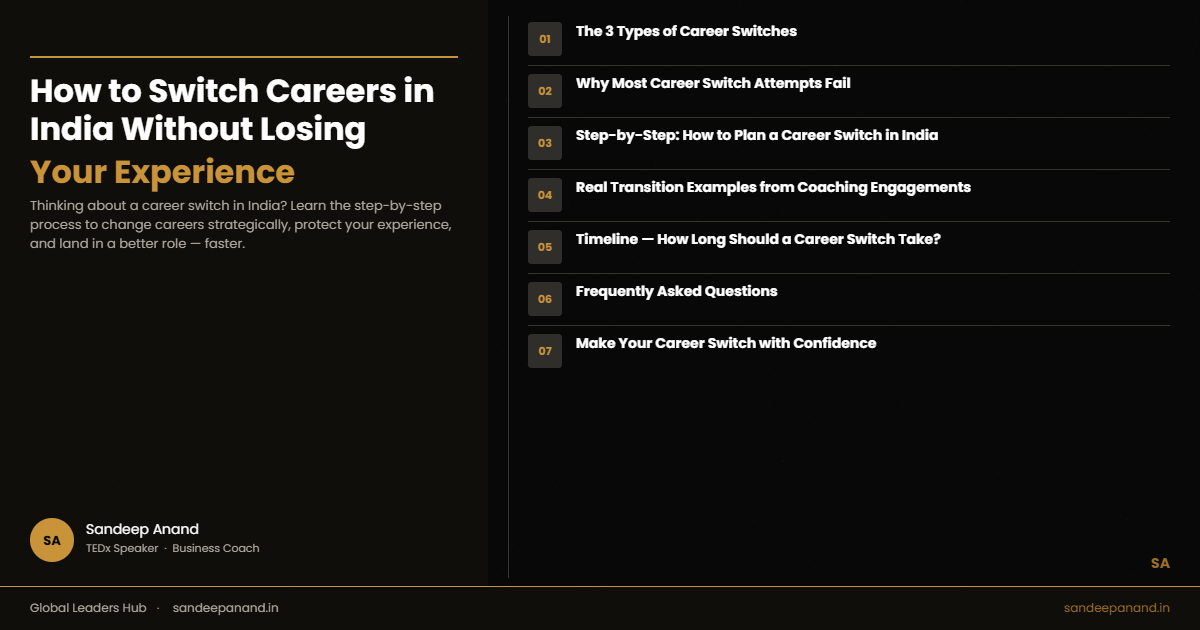
The 3 Types of Career Switches
Not all career switches are equal in complexity. Understanding which type you’re making changes the strategy significantly.
Lateral switch
Same function, different industry. Finance in banking → Finance in tech. Easiest to execute — industry knowledge transfers directly.
Diagonal switch
Adjacent function, adjacent industry. QA → Business Analyst. Developer → Technical PM. Requires repositioning but strong transferable value.
Full pivot
New function, new industry. Engineer → Marketing. Lawyer → Startup founder. Requires the most strategic preparation — but absolutely achievable.
Most professionals overestimate the type of switch they’re making. What feels like a full pivot is often a diagonal switch with good transferable foundations. A structured gap analysis clarifies this quickly.
Why Most Career Switch Attempts Fail
“Starting with tactics before defining strategy is the #1 reason career switches fail. You can’t tailor a resume to a role you haven’t clearly defined yet.”
⚠️ The most common mistake: strategy before clarity
Most professionals begin their career switch by updating their resume and starting to apply. This produces poor results because the resume is written for their current role — not their target. Applications go out to broadly defined targets. Rejections pile up. Confidence drops. The conclusion drawn (“I can’t make this switch”) is wrong — the process was wrong.
The Clarity Before Strategy™ principle applies directly here: before any application is sent, you need a precise target role, a clear narrative about why your experience is valuable for it, and a repositioned professional brand that reflects the transition.
Step-by-Step: How to Plan a Career Switch in India
Skills audit — transferable vs role-specific
List every skill you’ve demonstrated in your career. Separate them into two columns: transferable (leadership, communication, data analysis, problem-solving, project management, stakeholder management) and role-specific (knowledge specific to your current domain). You’ll be surprised how much of your value lives in the first column.
Target role research — what the market actually values
Study 20–30 job descriptions for your target role. Note which skills appear repeatedly. Cross-reference with your transferable skills list. This produces your actual gap — not your imagined gap, which is almost always larger.
Gap analysis — CBS™ visual framework
Map the distance between what you have and what the target role requires across skills, brand, visibility, and network. Most professionals find the skills gap is smaller than expected and the brand/visibility gap is larger. This changes where you invest your energy.
Brand repositioning — resume and LinkedIn for the new role
Rewrite your resume and LinkedIn headline and about section for your target role — not your current one. Every bullet point should be evaluated: does this help me land a [target role]? If not, cut or reframe it. Your past experience should tell the story of why you’re well-suited for the future you’re targeting.
Outreach and network activation
Identify people in your target role at companies you’re interested in. Request informational conversations — not job referrals. Learn from them. Build genuine relationships before you need something. Most good job opportunities come through this channel, not cold applications.
Interview preparation for career switchers
Career switcher interviews require a specific narrative: “why are you making this switch, and why now?” Prepare this story thoroughly. It should be honest, confident, and forward-looking — not apologetic. Your diverse background is an asset, and your story should present it that way.
Real Transition Examples from Coaching Engagements
These composite examples reflect common patterns seen across hundreds of career transition coaching engagements:
The timeline in each case was significantly shorter with structured coaching support than the average uncoached transition timeline of 12–18 months. The difference is not luck — it is process.
Timeline — How Long Should a Career Switch Take?
A structured, coached career switch in India typically takes 3–9 months from the decision to transition to landing in the new role. The range depends on:
- The type of switch (lateral switches are faster; full pivots take longer)
- The size of the skills gap
- The target industry’s hiring pace
- How actively the network is worked
- How quickly the brand repositioning is completed
What extends timelines most is not market conditions — it is starting applications before the brand repositioning is complete. Applications sent with a misaligned resume produce rejections that feel like market rejection, when in reality they are positioning rejections.
Frequently Asked Questions
Make Your Career Switch with Confidence
Book a Career Pivot Strategy session with Sandeep Anand. Get a structured plan — not more confusion.