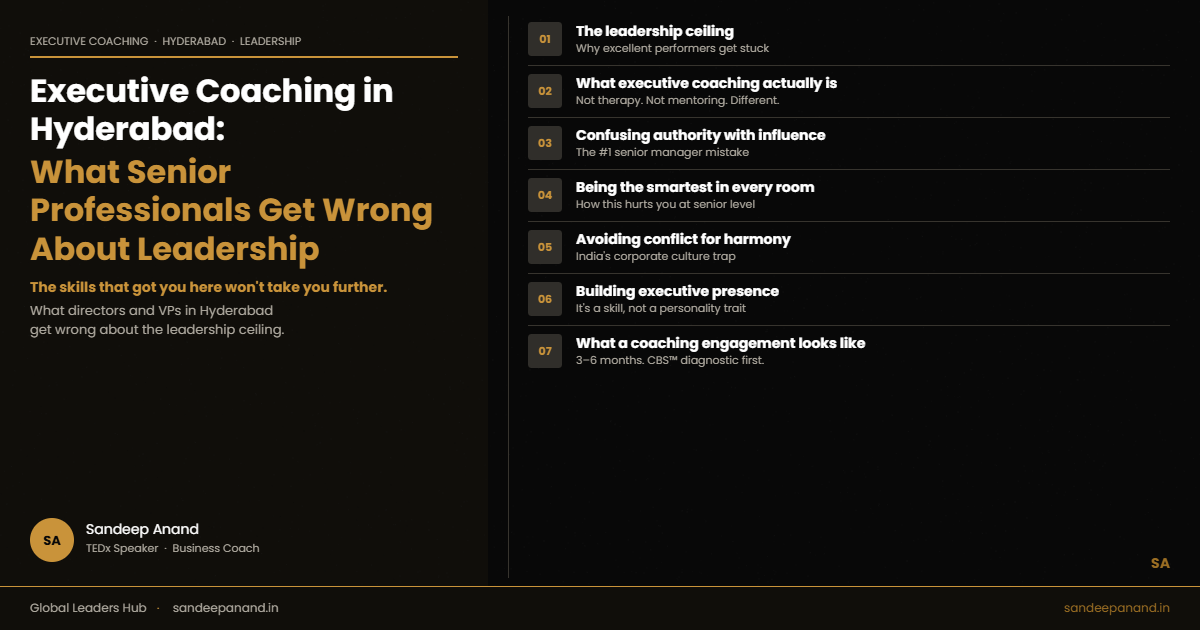
The leadership ceiling is real — and it's not about skill
The most common pattern I see at the senior level: the person is technically excellent, they've delivered, they've led teams. And yet they're not getting the next role. Or they got it and now feel out of their depth in a way they've never experienced before.
The skills that got you to senior manager are not the same skills that take you to director, VP, or CXO. This is the leadership ceiling — and it's a coaching problem, not a competence problem.
What executive coaching is — and what it isn't
- It is a structured, confidential thinking partnership with a coach who has no agenda except your growth.
- It is not therapy, mentoring, consulting, or training.
- It is a process of expanding your thinking and building the capabilities the next level demands.
Six things senior professionals in Hyderabad get wrong about leadership
1. Confusing authority with influence
At the individual contributor level, you deliver results. At the senior level, you create conditions for others to deliver. This requires influence, not authority — and most senior managers have been rewarded for the former, not trained for the latter.
2. Being the smartest person in every room
This worked brilliantly to get you promoted. It actively undermines your effectiveness at the senior level, where your job is to make the people around you better.
3. Avoiding conflict in the name of harmony
Hyderabad's corporate culture often values harmony and hierarchy. But senior leadership requires you to have difficult conversations, challenge bad decisions, and create psychological safety for disagreement.
4. Not investing in executive presence
Executive presence is not about speaking loudly or dressing well. It is about occupying your role with conviction. This is buildable — it is not a personality trait.
5. Skipping the strategy layer
Most senior managers in Hyderabad are operationally excellent. But the VP transition demands strategic thinking — seeing 2–3 years ahead, connecting function to business outcomes, deciding under ambiguity.
6. Waiting until they're stuck to get coaching
The best time to invest in executive coaching is when you're performing well and want to accelerate — not when you're already in trouble.
What an executive coaching engagement looks like
My engagements run 3–6 months with fortnightly sessions. We begin with the CBS™ diagnostic — establishing clarity about where you are, where you want to be, and what is actually in the way. Sessions are available in-person in Hyderabad or online. Visit sandeepanand.in/coaching/ or book at topmate.io/thesandeepanand.