You spent three months job searching. You aced four interview rounds. You received an offer 30% above your current package and handed in your resignation. And then your manager — who has not acknowledged your contributions in five years of appraisal conversations — suddenly found budget for a 25% raise, a title change, and the project scope you have been requesting since 2024.
This moment is one of the most emotionally charged and strategically consequential in a professional career. And it is the moment that Sandeep Anand at Global Leaders Hub, across 18+ years of coaching 100,000+ professionals in India, the USA, and the UK, most consistently sees handled incorrectly. Not because professionals are naive — but because counter-offers are architecturally designed to feel like validation, and validation is difficult to decline even when the data tells you to.
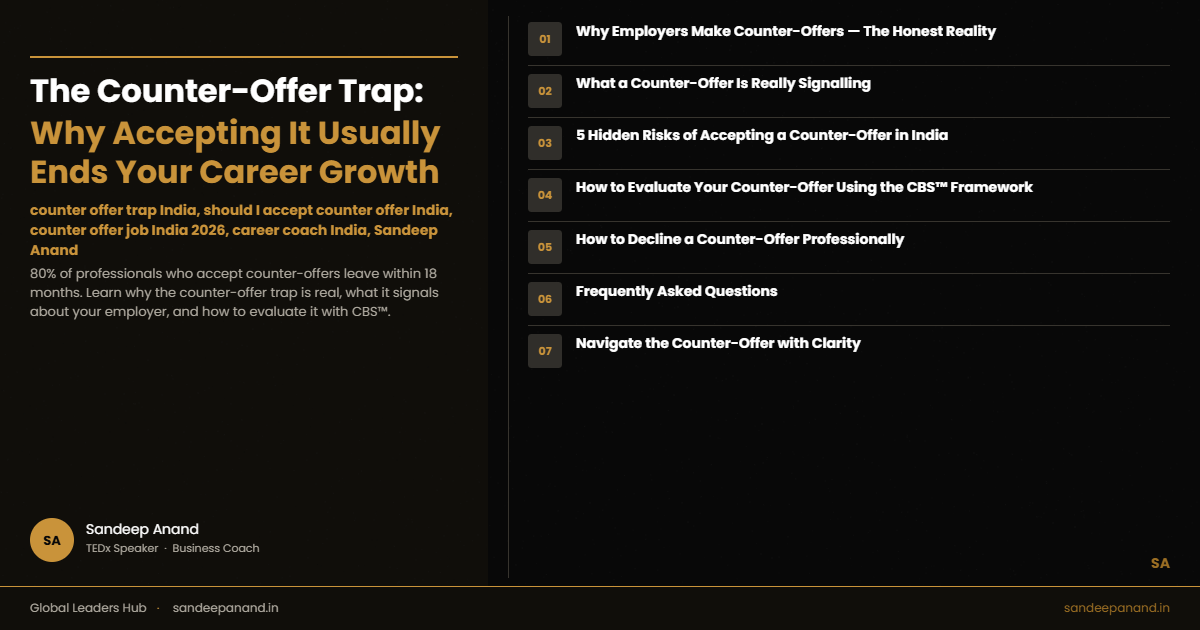
Why Employers Make Counter-Offers — The Honest Reality
Counter-offers are almost never motivated by a sudden recognition of your value. They are motivated by the cost of replacing you. For a mid-to-senior professional in India, the replacement cost — recruitment fees, onboarding time, knowledge transfer, team disruption — is typically 50–150% of annual salary. A counter-offer that costs the company 15% of your annual salary is dramatically cheaper than replacing you.
The budget for your counter-offer existed before you resigned. It was never allocated to you because it was not required — you were staying anyway. The moment you became a departure risk, the calculus changed. This is rational business management, not malice. But understanding it changes everything about how you interpret the gesture.
Replacement Cost Motive
Replacing a mid-senior professional in India costs 50–150% of annual salary. A counter-offer is almost always cheaper than replacement. It is a retention tool, not a recognition.
Short-Term Thinking
Counter-offers buy 6–18 months for the employer to backfill, reduce your critical dependency, or restructure. They are rarely part of a genuine long-term career investment.
The Loyalty Flag
Once you resign, you have been flagged as a flight risk in HR systems and in management thinking. This affects future project assignments, promotion decisions, and how your name is discussed in leadership planning conversations.
What a Counter-Offer Is Really Signalling
A counter-offer is confirming three things simultaneously: that you were being underpaid relative to what they were willing to pay; that the budget to pay you more always existed; and that your employer needed an external offer to trigger it. None of these three facts changes when you accept. You simply become aware of them while staying in the same organisation.
“The counter-offer is the organisation’s admission that they have been underpaying you. It is not a reward. It is a retention mechanism. The question is not whether to be flattered by it — it is whether the reasons you started looking have actually been resolved by it.”
5 Hidden Risks of Accepting a Counter-Offer in India
- 1
You are now a marked employee. Your name went on a flight-risk list the moment you resigned — formally or informally. Senior leaders and HR business partners in Indian corporates treat counter-accepted employees with heightened caution for 12–24 months. This manifests in exclusion from high-visibility projects, caution in promotion calibration, and reduced trust in strategic conversations.
- 2
Your counter-offer salary cannibalises future increments. Counter-offer salaries are frequently funded by pulling forward your next increment cycle. Professionals who accept and track their 2 and 3-year earnings trajectory often find slower total compensation growth than if they had taken the external offer with its compound effect.
- 3
The core reasons you wanted to leave have not changed. Counter-offers address compensation. They do not change management quality, role scope, growth ceiling, learning opportunities, cultural dynamics, or the structural reasons that caused your dissatisfaction. If any of those were primary factors, accepting the counter-offer leaves them entirely unaddressed.
- 4
The data says you will leave anyway. Research consistently shows 80%+ of professionals who accept counter-offers leave or are let go within 18 months. The counter-offer delays the inevitable — at the cost of the stronger external offer and the goodwill of the company you turned down.
- 5
You burn a real offer for uncertain promises. Once you decline the external offer, it is gone. Companies in India rarely re-extend declined offers. The verbal promises that came with your counter-offer — the project, the promotion, the management change — are commitments from an organisation that just demonstrated it only acts on your behalf when your departure is imminent.
How to Evaluate Your Counter-Offer Using the CBS™ Framework
The CBS™ Counter-Offer Evaluation Questions
Question 1: Was compensation the sole reason I started looking? If yes, and the counter-offer addresses it fully, the evaluation is more straightforward. If no — if growth, culture, management, or role fit were factors — the counter-offer has not addressed your core issue.
Question 2: Does the counter-offer include a documented structural change — a formal promotion, title change, specific role expansion with written scope — or just more money? Verbal promises from a surprised employer have a notoriously poor conversion rate in Indian corporate environments.
Question 3: Where do I want to be in 24 months, and which path gets me there more reliably? The external offer, the counter-offer, or neither? Your 24-month trajectory matters more than the next month’s pay cheque. This is the central CBS™ question.
Question 4: Am I accepting because this is genuinely right — or because accepting is easier than the discomfort of change? Inertia dressed as strategic reconsideration is the most common and most costly version of the counter-offer mistake.
How to Decline a Counter-Offer Professionally
If you have decided to decline — which in most cases is the right decision — doing it professionally is important for your reputation and for the quality of your exit through the notice period. The conversation should be warm, specific, and forward-looking:
“I genuinely appreciate this — it means a lot that the organisation values my contribution enough to respond this way. After careful thought, I have made the decision to pursue the external opportunity. It aligns with where I want to be professionally in the next 5 years in ways I do not see being possible here in the near term. I am fully committed to a smooth transition and want to leave on the best possible terms.”
If you want a structured CBS™ analysis of your specific counter-offer situation — what accepting vs declining means for your particular career trajectory and 24-month plan — a Career Guidance Session with Sandeep Anand at Global Leaders Hub provides both the framework and the conversation. Explore free consultation options as a first step.
Frequently Asked Questions
Navigate the Counter-Offer with Clarity
Book a Career Guidance Session with Sandeep Anand and get an honest CBS™ analysis of whether your counter-offer is the exception — or the trap.
Book Career Guidance Session →
Also explore: Career Pivot Strategy · All Services · Free Priority DM