A Reddit post titled “Moving back to India in mid-2026 after 5.5 years in the USA” went viral in late 2025 for a reason. The poster — a 29-year-old Indian professional on H1B in the Tri-State area — described an increasingly difficult calculation: solid income, but cost of living in the US that was hard to justify, combined with an immigration path that felt more uncertain than it had when he arrived. The response thread had hundreds of comments from Indian professionals across the USA who recognised the exact same tension.
This is not an isolated sentiment. It is a structural shift. The H1B changes of 2025–2026, combined with an unprecedented GCC hiring boom in India, rising quality of life in Hyderabad and Bengaluru, and the narrowing gap between US and India compensation for premium roles, have made the NRI career decision more genuinely bilateral than at any point in the past two decades. Sandeep Anand at Global Leaders Hub has coached hundreds of Indian professionals through this exact decision across India, the USA, and the UK, applying the CBS™ (Clarity Before Strategy™) framework.
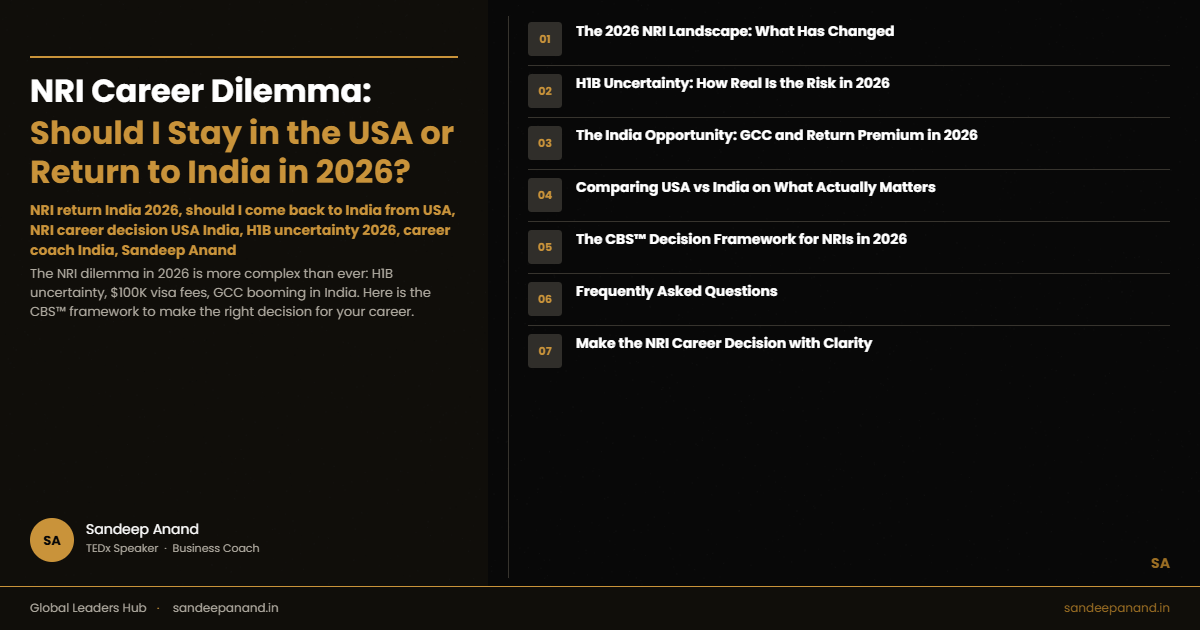
The 2026 NRI Landscape: What Has Changed
The conditions that made “stay in the USA at all costs” the default strategy for Indian professionals have changed materially in 2025–2026. Several simultaneous shifts have altered the bilateral calculation:
- 1
H1B now costs $100,000 for new petitions in some categories. The September 2025 H1B fee change — a $100,000 surcharge on new petitions in certain cases, representing a 9,000%+ increase from the previous range — changed the financial calculus for both employers and professionals. Companies are becoming more selective about H1B sponsorship; Indian professionals are recalculating whether the US employment relationship is as stable as previously assumed.
- 2
Wage-based H1B selection replaces the lottery. The proposed shift from the random H1B lottery to wage-based selection — prioritising higher-paid roles — benefits highly-paid professionals at FAANG and major tech companies but makes the path significantly harder for those at IT consulting firms and mid-tier employers. The bifurcation of H1B into premium and commodity tiers is accelerating.
- 3
India’s GCC sector has reached unprecedented scale. 1,700+ Global Capability Centres are now operating in India. The sector is projected to add 4.5 lakh new jobs in 2026. US-origin GCCs at Goldman Sachs, JPMorgan, Google, Microsoft, and Amazon in Hyderabad and Bengaluru are offering compensation that approaches 60–80% of US packages — with India’s purchasing power adjustment, this is a genuinely competitive proposition.
H1B Uncertainty: How Real Is the Risk in 2026
The H1B risk in 2026 is highly variable by employer and employment structure. Indian professionals at FAANG, major financial institutions, and top-tier tech companies on direct payroll are relatively insulated: these companies have the budget for H1B fees, meet the wage-based selection criteria for the new system, and have legal teams that navigate regulatory changes effectively. The risk profile is very different for professionals at IT consulting firms, staffing agencies, or smaller employers who have historically been the most H1B-dependent and who are the most affected by the fee and wage changes.
| Employment Type | H1B Risk in 2026 | India GCC Alternative |
|---|---|---|
| FAANG / Major Tech direct hire | Low — well-funded, compliant, high-wage | FAANG GCC India at 60–80% of US comp |
| Mid-tier tech / product companies | Moderate — fee burden, wage compliance pressure | Strong GCC pipeline in same sector |
| IT consulting / staffing (TCS US, Infosys BPM) | High — most exposed to wage and fee changes | Returning to India offices of same companies feasible |
| Healthcare / financial services non-tech | Moderate — sector-specific considerations | India GCC roles in BFSI and healthcare growing |
The India Opportunity: GCC and Return Premium in 2026
The most significant development in the NRI career decision calculus in 2026 is the scale and quality of the India GCC opportunity. Indian professionals returning from the USA to GCC roles in Hyderabad, Bengaluru, or Mumbai can realistically target ₹40–80 LPA for mid-senior technology and product roles, with senior positions at major US-origin GCCs reaching ₹1 crore+ in total compensation. This is not the India career market of 2015 or even 2020.
The purchasing power comparison changes the numbers further. ₹60 LPA in Hyderabad — with potential for owned or low-cost housing, no visa uncertainty, proximity to family, and significantly lower cost of living than the Bay Area or New York — represents an effective quality of life that a $130,000 salary in California with $3,500/month rent and active immigration anxiety cannot straightforwardly beat. The calculation is genuinely bilateral in 2026 in a way it was not before.
Comparing USA vs India on What Actually Matters
The CBS™ NRI Decision Framework: What to Actually Compare
Financial: Compare after-tax savings rate, not gross salary. US healthcare costs, housing, childcare, and tax often absorb 50–60% of gross income for a Bay Area family. India GCC salaries with lower fixed costs can produce comparable savings rates.
Career: What is your 5-year career trajectory in the USA vs India? Is the US role providing FAANG-level growth, or have you plateaued? Are India GCC roles in your sector at a level that challenges and develops you?
Immigration: What is your realistic green card timeline? EB-2/EB-3 backlogs for Indian nationals are 80+ years at current processing rates. Is indefinite H1B dependency sustainable for your family situation and risk tolerance?
Lifestyle and family: What does proximity to parents and extended family mean to you as you move into mid-career and they move into later life? What does your partner’s career look like in both scenarios?
Long-term life design: Not “where am I comfortable now” but “where do I want to build my life, raise my children, and be 20 years from now?” The CBS™ framework ensures this question is asked and answered honestly — not avoided because it is uncomfortable.
The CBS™ Decision Framework for NRIs in 2026
The NRI stay-vs-return decision is one of the most complex career decisions a professional can face — because it involves financial, professional, family, identity, and lifestyle variables simultaneously, and because the stakes are high in both directions. The CBS™ framework at Global Leaders Hub structures this decision through a coached process that surfaces each of these dimensions, identifies your actual priorities (which often differ from your stated ones), and builds a decision framework that you can act on with confidence rather than continuing to defer.
Sandeep Anand has coached Indian professionals at Google, Microsoft, Amazon, Goldman Sachs, and JP Morgan who returned to GCC roles in India — and professionals who evaluated the same decision and chose to stay in the USA with a clearer strategy for making it work. Neither outcome is universally correct. The CBS™ process produces the right answer for your specific situation. Book a Career Guidance Session at Global Leaders Hub — conducted online for NRI professionals worldwide. Explore all coaching services for more options.
Frequently Asked Questions
Make the NRI Career Decision with Clarity
Book a Career Guidance Session with Sandeep Anand — and get a CBS™-structured analysis of your USA vs India career decision based on your specific situation.
Book Career Guidance Session →
Also explore: Future-Proofing Your Career · All Services · Free Priority DM