A 30-minute salary negotiation conversation can add ₹5–15 lakh to your annual income — and compound that into ₹50–80 lakh of additional lifetime earnings. This is not a theoretical calculation. It is the mathematical reality of how a higher starting salary compounds through future increments, role changes, and promotions over a 25-year career. Yet most Indian professionals, from freshers at Infosys to senior engineers at Amazon, walk away from this conversation entirely — either because they are afraid of losing the offer, or because they simply do not know how to have it.
Sandeep Anand, TEDx Speaker and Founder of Global Leaders Hub, has coached 100,000+ professionals across India, the USA, and the UK through this exact inflection point. The CBS™ (Clarity Before Strategy™) principle applies here as acutely as anywhere else in career management: you cannot negotiate effectively without first knowing exactly what your market value is, what your non-negotiables are, and what outcome you are negotiating toward. This article gives you all three.
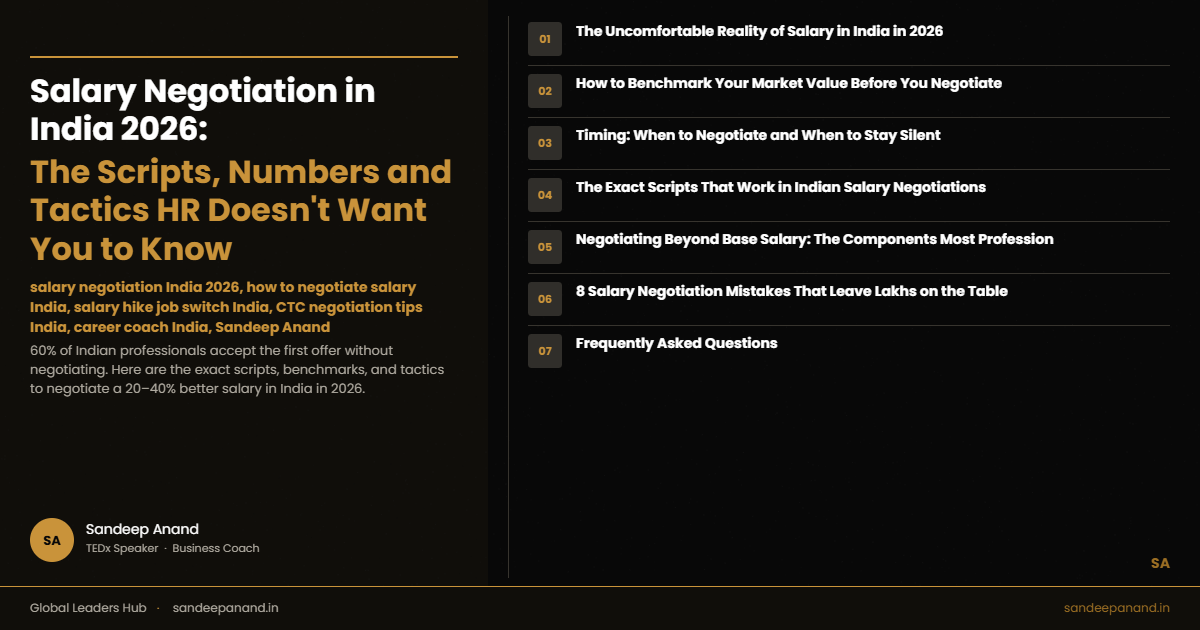
The Uncomfortable Reality of Salary in India in 2026
The data on salary satisfaction in India is damning. A foundit survey found that 47% of Indian professionals are not satisfied with their salary growth, citing low increments and unfulfilled expectations. Another survey found that 40% of professionals feel their salary is below industry standards — yet 14% remain unaware of benchmarks in their own field. This combination of dissatisfaction and ignorance is the structural condition that allows companies to underpay consistently.
The mechanism is straightforward. India’s job market has historically been opaque about compensation — companies use phrases like “best in industry” without stating ranges, candidates do not share salary data with peers, and cultural norms make discussing money uncomfortable. HR departments in India are trained to keep hiring costs low. The candidate who walks in without benchmarks, without a clear ask, and without the willingness to push back will almost always leave underpaid.
Internal Hike Reality
IT services (TCS, Infosys, Wipro) give 8–15% for average performers in 2026. Top performers get 15–20%. Staying put costs you 20–30% vs the external market every 2–3 years.
External Switch Premium
Average salary jump from a job switch in India in 2026 is 20–40%. GCCs and product companies regularly offer 30–50% for the right profile. This is the incentive to move — and to negotiate.
First Offer Reality
85% of Indian employers expect negotiation. Companies routinely open 10–20% below their budget. Accepting the first offer signals that you will accept below-market compensation — now and in the future.
How to Benchmark Your Market Value Before You Negotiate
The single biggest mistake Indian professionals make in salary negotiation is negotiating without data. Walking into a conversation with a vague sense that you deserve more is not a negotiation strategy. Walking in with three salary benchmarks from credible sources, a clear articulation of your specific value, and a target number you can defend is.
The most reliable salary benchmarking sources for Indian professionals in 2026:
- 1
AmbitionBox India — 4 crore+ salary data points for Indian companies and MNCs, filterable by company, role, city, and experience. The most India-specific dataset available and the most credible to cite in a negotiation conversation.
- 2
levels.fyi India filter — Verified compensation data for tech companies and GCCs in India. If you are targeting a product company or GCC, this is your go-to source. Data is anonymously self-reported and verified.
- 3
LinkedIn Salary Insights — Role and location-based salary benchmarking based on LinkedIn member data. Particularly useful for understanding the range across companies in your target function.
- 4
Peer conversations — The most underutilised source. One direct conversation with a peer in your target company or a similar role — even anonymously through a mutual contact — gives you more actionable data than any public tool. Build the habit of having salary conversations with trusted professional peers.
Once you have three data points, construct your target range. The lower end of your range should be your minimum acceptable offer. Your opening ask should be at the upper end or slightly above — giving you room to negotiate down while still landing above your minimum. Never give a single number first. Ranges give you movement.
“Salary negotiation in India is not about being greedy. It is about being informed. The professional who knows their market value and articulates it clearly is respected. The one who guesses and hopes is taken advantage of — not because companies are villainous, but because underpaying the unaware is simply good business for them.”
Timing: When to Negotiate and When to Stay Silent
Timing in salary negotiation is as important as the content of the negotiation itself. There are three moments in a hiring process where your leverage is at its peak — and three where it is at its lowest. Understanding which is which changes everything.
| Moment | Your Leverage | What to Do |
|---|---|---|
| During the first interview | Very Low | Deflect salary questions — “I’m open to discussing compensation based on the full scope of the role” |
| After screening, before final interview | Low | Give a range if pressed, but do not anchor low |
| After receiving verbal offer | High | Pause, thank them, say you’ll revert in 24–48 hours |
| After receiving written offer | Highest | Negotiate everything — base, variable, joining bonus, review cycle |
| After signing the offer | Zero | You have accepted — the negotiation is over |
| During notice period buyout pressure | Moderate | Negotiate joining bonus to offset notice period risk |
The most important rule: never negotiate salary during the interview. The company has not yet decided they want you. Once the written offer arrives, they have invested time, budget, and internal alignment in selecting you specifically — and they do not want to restart the search. That investment is your leverage.
The Exact Scripts That Work in Indian Salary Negotiations
The following scripts are drawn from Sandeep Anand’s coaching at Global Leaders Hub across 100,000+ professionals in India, the USA, and the UK. They are adapted for Indian professional contexts and cultural norms around directness and deference.
When asked “What is your current CTC?”
“My current CTC is ₹[X] LPA — that includes fixed and variable components. Based on my research on market rates for this role and the scope you’ve described, I’m targeting ₹[Y–Z] LPA. I’m confident we can find something that works for both of us.”
When responding to the initial offer
“Thank you — I appreciate the offer and I’m genuinely excited about this opportunity. I’d like 24 hours to review the full details before responding. I may have a few questions on the compensation structure.”
When countering the offer
“I’ve reviewed the offer carefully and I’m very interested in joining the team. Based on the market benchmarks I’ve researched — and the specific scope of this role, which includes [one key responsibility they emphasised] — I was expecting something closer to ₹[X] LPA. Is there flexibility on the base salary to get us to that range?”
When they say “This is our best offer”
“I understand, and I appreciate the transparency. If the base salary has a ceiling, could we discuss a joining bonus to bridge the gap — or a performance review at 6 months rather than 12? I want to make this work, and I think there’s a structure that reflects the value I’ll bring from day one.”
When handling current employer’s counter-offer
“I appreciate the gesture, and I want to be transparent — my decision to explore this move is not primarily about salary. I’m looking for [growth opportunity / expanded scope / specific factor]. If that is something you can offer alongside the revised package, I’m open to reconsidering. Otherwise, I think the external move is the right step for me at this point in my career.”
Negotiating Beyond Base Salary: The Components Most Professionals Miss
Base salary is one line on an offer letter. Total compensation is everything. Indian professionals who focus exclusively on base CTC frequently miss negotiation opportunities that can add ₹2–8 lakh of additional value to their package without the company needing to increase the budget line they are protecting. These are the components to negotiate when base salary hits a ceiling:
- 1
Joining bonus. Often used to compensate for lost variable pay, unvested stock, or notice period risk. Common at product companies and GCCs, increasingly common at IT services firms for senior hires. Ask for a specific amount tied to a specific rationale — “to offset my unvested RSUs vesting in September” is more compelling than a generic request.
- 2
Variable pay structure. If your fixed pay cannot move, negotiate the target variable percentage and the clarity of the metrics used to calculate it. A 20% variable with clear, achievable metrics is more valuable than a 25% variable with ambiguous criteria that management consistently pays at 60%.
- 3
Accelerated performance review. Negotiate a 3 or 6-month salary review tied to specific performance milestones. Get it in writing in the offer letter, not as a verbal promise. This is one of the most commonly agreed-to concessions when base salary is fixed — and frequently forgotten unless documented.
- 4
Title and designation. In India’s corporate hierarchy, designation affects both career trajectory and future salary negotiations. If you are being offered a role one grade below your current level, negotiate the title explicitly — even if total compensation is higher.
- 5
ESOPs or RSUs. At product companies and some GCCs, equity is a meaningful component of total compensation. Understand the vesting schedule, cliff, and fair market valuation methodology before signing. ESOPs at early-stage companies are speculative; RSUs at public companies are more predictable.
8 Salary Negotiation Mistakes That Leave Lakhs on the Table
The 8 Mistakes CBS™ Coaching Consistently Identifies
1. Accepting the verbal offer in the meeting. Always buy 24–48 hours. Enthusiasm leads to poor decisions.
2. Apologising for negotiating. Every employer expects it. Apologising signals you are not confident in your value.
3. Giving a single number instead of a range. A single number feels like an ultimatum. A range gives you room to move and them room to feel they won.
4. Letting your current CTC anchor your ask. Your future salary should be based on market value and role scope — not on what you happened to be paid at your last job.
5. Negotiating over email when a call is possible. Tone matters enormously. A negotiation conversation conducted warmly on a call achieves better outcomes than a cold email counter-offer that reads as transactional.
6. Not getting revised offers in writing. Verbal commitments — especially promises of review cycles, bonus structures, or title upgrades — are meaningless without documentation.
7. Accepting the counter-offer from your current employer without analysis. Counter-offers are rarely genuine career investments. They are short-term retention tools. The reasons you wanted to leave almost never change because of a salary bump. Explore our coaching services to evaluate your counter-offer situation with clarity.
8. Negotiating without a walkaway number. Know your minimum before the conversation starts. A professional who does not know their walkaway number cannot negotiate effectively — they end up accepting whatever is in front of them because they have no alternative anchor.
Frequently Asked Questions
Negotiate the Salary You Actually Deserve
Book a Career Guidance Session with Sandeep Anand and walk into your next negotiation with a CBS™-backed strategy, benchmarked numbers, and scripts that work.
Book Career Guidance Session →
Also explore:
Hired 2.0 Course ·
All Coaching Services ·
Free Priority DM