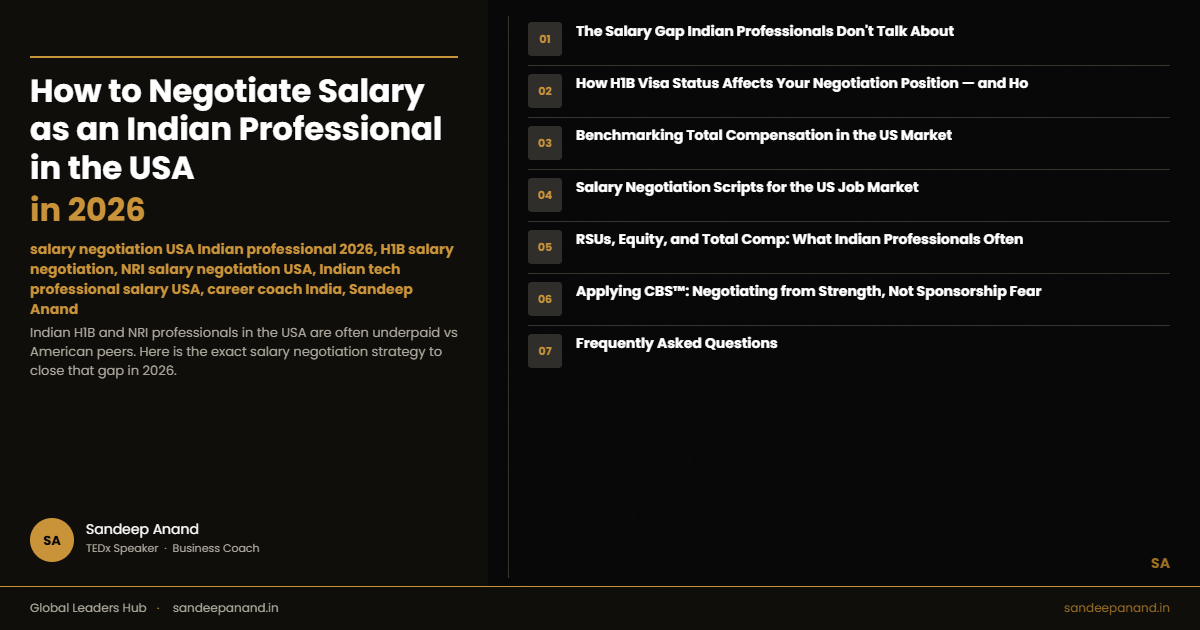
- The Salary Gap Indian Professionals Don’t Talk About
- How H1B Visa Status Affects Your Negotiation Position
- Benchmarking Total Comp in the US Market
- Negotiation Scripts for the US Job Market
- RSUs, Equity, and Total Comp: What Indians Often Miss
- Applying CBS™: Negotiating from Strength, Not Fear
- Frequently Asked Questions
There is a conversation that happens in WhatsApp groups and Blind threads among Indian professionals in the Bay Area, Seattle, and New York that rarely makes it into formal career discourse: why are so many Indian engineers, product managers, and analysts earning $20,000–$50,000 less than their American colleagues for the same role at the same company? The answer is not a conspiracy. It is a structural pattern — and it is 100% addressable through informed, deliberate salary negotiation.
Sandeep Anand at Global Leaders Hub has coached Indian professionals in the USA and the UK using the CBS™ (Clarity Before Strategy™) framework. The pattern across these engagements is consistent: Indian professionals on H1B visas or early in their US career consistently undervalue themselves, accept first offers, and anchor their US salary on their Indian CTC converted to dollars — one of the most damaging salary decisions a professional can make.
The Salary Gap Indian Professionals Don’t Talk About
The US Department of Labor’s H1B public disclosure database reveals something that most Indian professionals never look up: the prevailing wages filed by their employer for their H1B petition. In thousands of cases — particularly at IT services firms like TCS, Infosys, and Wipro operating in the US — these wages are filed at Level I or Level II, which are the bottom two tiers of the prevailing wage system designed for entry-level or limited-experience workers. Mid-level and senior Indian professionals are frequently placed at these lower wage tiers, creating a structural underpayment that compounds over years.
The US DoL’s proposed H1B wage reform, announced in May 2026, explicitly acknowledged this problem — noting that the current wage system had remained largely unchanged for nearly 20 years and no longer reflects real market salaries. The proposed increases of 21–33% across job categories are the government’s recognition that systematic H1B underpayment is real and documented. For Indian professionals in the USA, this is both a validation and an actionable signal: the market is moving toward correct pricing of your skills, and you should be moving there faster than any regulation forces you to.
The Consulting Firm Problem
IT consulting companies (TCS US, Infosys BPM, Wipro Americas) routinely file H1B wages at Level I–II tiers, creating a documented underpayment structure that persists across renewals unless the professional actively pushes back or changes employers.
The Compounding Cost
A $20,000 annual salary gap at age 30 compounds across a career into hundreds of thousands of dollars of lost lifetime earnings — plus lower 401k contributions, lower RSU grants, and a lower baseline for future negotiations.
The AC21 Opportunity
After 180 days with an approved I-140, your H1B is portable to a new employer. This means a competing offer is legally available far earlier than most Indian professionals realise — fundamentally changing your negotiation position.
How H1B Visa Status Affects Your Negotiation Position — and How to Work Around It
The H1B’s dependency on employer sponsorship creates what Sandeep Anand calls the sponsorship trap in coaching conversations: the rational fear that pushing back on compensation will cost you your visa and your ability to remain in the US. This fear is not irrational — it is based on real structural risk. But it is also dramatically over-weighted by most Indian professionals, leading to consistent under-negotiation across their entire US career.
The practical realities that change the negotiation calculus:
- 1
H1B transfers are common, straightforward, and do not require a new lottery. Changing employers while on H1B does not require re-entering the lottery if you already hold an approved H1B. A new employer files an H1B transfer petition, and you can typically begin working immediately upon filing. The fear that changing jobs means losing your H1B is the single most financially damaging misconception among Indian professionals in the US.
- 2
AC21 portability makes you a free agent after 180 days. If your I-140 (green card petition) has been approved for at least 180 days, you can change employers to a same or similar role without restarting your priority date. This is a legal protection that transforms your negotiation position from hostage to professional — and most Indian professionals are unaware of it until they meet with an immigration attorney or a career coach who covers this ground.
- 3
Employers need you as much as you need them. The 2026 H1B wage reform proposals specifically target the wage suppression dynamic at IT consulting firms. Companies that genuinely need your skills — GCCs, product companies, FAANG — are not withholding compensation because of H1B. They are competitive on compensation. It is the staffing and consulting model, not H1B as a policy, that creates the underpayment environment.
“The greatest salary negotiation error I see Indian professionals make in the USA is negotiating from fear of visa loss rather than from knowledge of options. Once you understand your portability rights, your competing offer capability, and your actual market value — the conversation changes entirely.”
Benchmarking Total Compensation in the US Market
Total compensation benchmarking in the US is fundamentally different from CTC benchmarking in India. In India, total compensation is relatively straightforward — fixed salary plus variable plus benefits. In the US market, particularly at tech companies and GCCs, total compensation includes base salary, annual cash bonus, RSU or ESOP grants (typically with 4-year vesting schedules and 1-year cliffs), and benefits including 401k matching, health insurance, and other perks. The gap between base salary and total compensation at top-tier US employers can be 40–100%.
| Comp Component | IT Consulting (India firms) | US Product Co / GCC |
|---|---|---|
| Base salary | Often at prevailing wage Level I–II | Market rate, benchmarked to levels.fyi |
| Annual bonus | Small or variable, often not paid fully | 10–20% of base, typically fully paid |
| RSUs / Stock | Rare or minimal | $20,000–$100,000+/year at senior levels |
| 401k match | Minimal or capped | 4–6% match, often with immediate vesting |
| Signing bonus | Rare | Common to offset notice periods or unvested stock |
The most reliable benchmarking tools for Indian professionals in the US: levels.fyi (verified total comp by company, level, and location — the gold standard for tech companies), the DoL H1B disclosure database (shows actual prevailing wages filed by your employer and competitors — look up your company and your peer companies), and Glassdoor US with location filters. Always benchmark total annual compensation — base plus average bonus plus annualised RSU value — not just base salary.
Salary Negotiation Scripts for the US Job Market
The US job market is more direct about compensation than India’s — but Indian professionals often default to overly deferential language that signals they will accept whatever is offered. The following scripts are calibrated for US professional norms: direct, warm, and confident.
When asked “What are your salary expectations?” in the US
“Based on my research on levels.fyi and Glassdoor for this role and location, and the scope of what you’ve described, I’m targeting a total comp in the range of $[X]–$[Y]. I’m more focused on finding the right role than optimising a specific number — can you share the budgeted comp range for this position?”
When countering a US job offer
“Thank you for the offer — I’m genuinely excited about this opportunity and the team. I’ve done some benchmarking and the total comp is a bit below what I’ve seen for this level at comparable companies. Is there room to get the base to $[X], or alternatively, could we look at the signing bonus or RSU grant to close the gap?”
When your current employer offers a counter-offer to retain you
“I appreciate the gesture. I want to be honest — my decision to explore this move isn’t purely about compensation. I’ve been looking for [expanded ownership / faster GC sponsorship / different tech stack / better management]. If you can address that alongside the salary correction, I’m genuinely open to staying. Otherwise, I think this is the right next step for my career.”
RSUs, Equity, and Total Comp: What Indian Professionals Often Miss
One of the most consistent gaps Sandeep Anand identifies when coaching Indian professionals in the US is the underweighting of equity compensation. Indian professionals who grew up in India’s salary culture — where equity is rare, speculative, and often not received — frequently under-negotiate RSU grants at US companies where equity is a primary compensation component.
At public US tech companies and GCCs, RSU grants are real money with predictable value. A $150,000 RSU grant with a 4-year vesting schedule is $37,500 per year of additional compensation — more than many Indian professionals’ entire annual salary in India. Negotiating RSU grants upward by $25,000–$50,000 at the time of offer is common, straightforward, and frequently accepted by companies that cannot move base salary due to internal band constraints. Do not leave equity on the table because it feels abstract. It is cash with a vesting schedule.
Applying CBS™: Negotiating from Strength, Not Sponsorship Fear
Sandeep Anand’s CBS™ (Clarity Before Strategy™) framework applied to salary negotiation in the US context for Indian professionals structures the preparation into three phases that address both the financial and the psychological dimensions of the challenge:
The CBS™ US Salary Negotiation Framework
Clarity: Know your exact market value — base, bonus, equity, and total comp — from at least three reliable sources. Know your visa portability position. Know your walkaway number. Know whether your priority is total comp, green card sponsorship timeline, career growth, or some combination.
Positioning: Frame every salary conversation around your market value and the value you bring to this specific role — not your current employer’s prevailing wage filing, not your India CTC converted to dollars, not your desperation to stay in the country. Your positioning language determines whether you are seen as a negotiating professional or a candidate to be processed at minimum cost.
Strategy: Identify your target, your opening, and your fallback before any conversation. Know which components you will negotiate sequentially if the first ask is declined. Prepare your competing offer or competing interest — even a genuine alternative that is not yet an offer can be mentioned as “I am in conversations with a few other companies” without specifics.
For Indian professionals in the USA navigating both compensation negotiation and the visa complexity that underlies it, a Career Guidance Session with Sandeep Anand provides both the strategic framework and the specific coaching for your situation — whether you are on OPT, STEM OPT, H1B, or considering a return to India via GCC roles. Explore all coaching services at Global Leaders Hub.
Frequently Asked Questions
Negotiate Your True Market Value in the USA
Book a Career Guidance Session with Sandeep Anand — and get a CBS™-backed salary negotiation strategy built for your specific H1B, NRI, or US career situation.
Book Career Guidance Session →
Also explore:
Future-Proofing Your Career ·
All Coaching Services ·
Free Priority DM