You did not see it coming. Or maybe you did — the whispered rumours, the cancelled projects, the performance-review resets. Either way, you are now holding a termination letter in one of the most unsettled tech job markets India has seen in a decade. Here is what you need to understand immediately: this layoff is not a verdict on your ability. It is a structural market event — and the professionals who recover fastest are the ones who treat it that way.
India’s tech sector has eliminated tens of thousands of roles in 2026, not because professionals are failing, but because companies are restructuring aggressively to fund AI transformation. Oracle, Amazon, Meta, and domestic players like Axis Bank have all made significant cuts. TCS, Infosys, and Wipro are recalibrating bench strength. Understanding this context is not about making you feel better — it is about helping you make smarter decisions than the 84% of Indian professionals who, according to a LinkedIn survey published in January 2026, feel unprepared to find their next role.
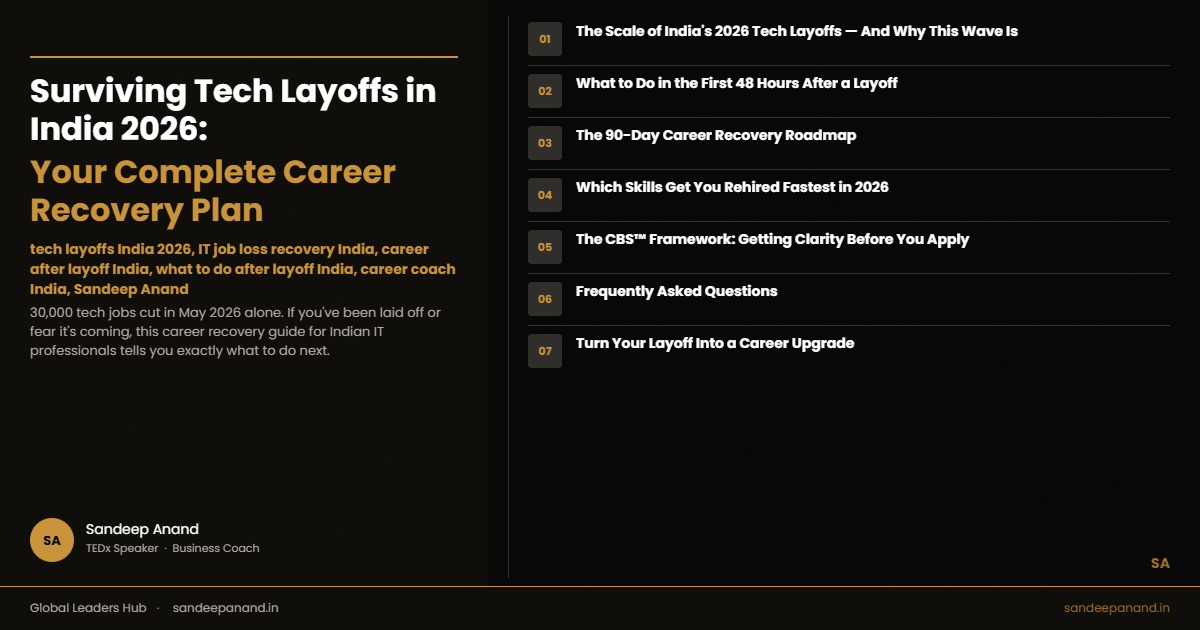
The Scale of India’s 2026 Tech Layoffs — And Why This Wave Is Different
India’s $250+ billion IT services industry is going through what analysts are calling a structural recalibration. This is not a seasonal correction or a post-COVID hangover. Global companies are deliberately reducing headcount to free up capital for AI infrastructure investment — and India’s large delivery centres are disproportionately affected because they were built on models of repetitive, process-heavy work.
What makes 2026 different from the 2023 layoff wave is the type of role being cut. In 2023, it was mostly attrition management and project wind-downs. In 2026, it is role redesign at scale. Manual quality assurance, level-1 support, basic data entry, legacy application maintenance, and routine recruitment functions are being automated or consolidated. This means the professionals most at risk are those whose primary value was volume output rather than judgment, strategy, or domain depth.
The good news — and this is real — is that the same transformation creating displacement is also creating significant demand. GCCs (Global Capability Centres) are hiring 4.5 lakh professionals in 2026. AI-native companies are building new functions. Product management, data science, cybersecurity, cloud architecture, and AI engineering roles are commanding premium salaries. The challenge is positioning for that demand — which is exactly what this article addresses.
Roles at Highest Risk
| Role Category | Risk Level | Why |
|---|---|---|
| Manual QA / Testing | Very High | AI-automated test generation replacing manual cycles |
| Level-1 IT Support | Very High | Chatbots and self-service AI handling routine tickets |
| Data Entry / Reporting | High | RPA and AI tools automating data workflows |
| Routine Recruitment | High | AI screening replacing initial candidate review |
| Legacy App Maintenance | High | Code migration and cloud consolidation reducing need |
| Mid-level Software Dev (generic) | Moderate | AI coding tools compressing team sizes |
| Product Management | Low | Judgment and strategy roles AI cannot fully replace |
| Data Science / AI Engineering | Very Low | In high demand; supply short |
What to Do in the First 48 Hours After a Layoff
The first two days matter more than the next two weeks. Most professionals waste this window in one of two ways: they either spiral into anxiety and inaction, or they fire off 50 applications to anything resembling their old role. Both paths lead to suboptimal outcomes. Here is the structured approach that Sandeep Anand’s coaching at Global Leaders Hub recommends for clients at this exact crossroads.
- 1
Read your severance agreement before signing anything. You typically have 30 days. Do not sign in the exit meeting under pressure. Review what you are entitled to — severance pay, ESOP vesting, non-compete clauses, and reference policy. If in doubt, seek legal advice. Many professionals in India sign away rights to additional benefits in the first 24 hours simply because they did not read carefully.
- 2
File your PF and gratuity claims immediately. Do not wait for your ex-employer to initiate. Log into the EPFO portal and verify your UAN is active. If your PF is with the employer’s trust, contact HR directly. For gratuity, you are eligible if you have completed 5 years of continuous service.
- 3
Activate your LinkedIn to ‘Open to Work’ (recruiter-only mode). Go to your LinkedIn profile, click ‘Open to Work’, and select ‘Recruiters only’ so the green banner does not show publicly. This immediately signals your availability to talent acquisition teams at GCCs, product companies, and IT firms without telegraphing your status to your professional network before you are ready.
- 4
Audit your financial runway. Calculate how many months you can operate at current burn before financial pressure forces a decision. If you have 4+ months, you can be strategic. If you have less than 2 months, a bridge role while building your target application pipeline is a sensible parallel track — not a capitulation.
- 5
Do not update your resume yet. This sounds counterintuitive but is critical. Updating your resume before you have clarity on your target role, industry, and positioning means you will write a generic document that tries to appeal to everyone and lands with no one. Get clarity first. Strategy second.
“A layoff is not a full stop. It is a comma. What comes next is not determined by what just happened — it is determined by the quality of thinking you do in the next 30 days. Clarity before strategy is not a slogan. It is the difference between a career upgrade and a lateral shuffle.”
The 90-Day Career Recovery Roadmap
The CBS™ (Clarity Before Strategy™) methodology that Sandeep Anand has applied across 100,000+ coaching engagements across 32 countries structures career recovery into three distinct phases. This is not a motivational framework — it is a practical operating model for professionals who need to move with both speed and precision in a competitive market.
Days 1–30: Clarity Phase
Define your target role, target companies, and non-negotiables. Audit skills against market demand. Identify your strongest proof points. Book a career clarity session to get an external, expert view before you start sending applications.
Days 31–60: Positioning Phase
Rebuild your resume and LinkedIn profile around your target role, not your last role. Begin upskilling in one high-value area. Reconnect with your professional network strategically — not broadcast-style, but one conversation at a time.
Days 61–90: Active Search Phase
Apply to 5–8 highly targeted roles per week, not 50 generic ones. Prepare for interviews with structured behavioural and technical practice. Use referrals wherever possible — GCCs especially fill 40–60% of roles before they are publicly posted.
One common mistake professionals at TCS, Infosys, Amazon, and Google make after a layoff is skipping the clarity phase entirely. They jump from job loss to resume update to application in under a week. The result is a poorly positioned application going to companies that are not the right fit, followed by silence, followed by desperation — and eventually a role that feels like a step sideways or backwards.
The 90-day structure is not about slowing you down. It is about ensuring that when you accelerate — in phase three — you are moving in the right direction with the right positioning. Professionals who follow this structure consistently land stronger roles than those who shotgun their search immediately.
Which Skills Get You Rehired Fastest in 2026
The 2026 hiring market in India is bifurcated in a way it has never been before. On one side, generic tech roles are oversupplied — hundreds of applicants per position. On the other side, roles requiring a combination of technical fluency, AI literacy, and domain expertise are chronically undersupplied. The professionals who move from the first group to the second in the next 90 days will be the biggest winners of this disruption cycle.
Skills that are commanding hiring premiums across companies operating in India, USA, and UK in 2026 include:
- 1
AI integration skills (non-coding roles). You do not need to be an ML engineer. Business analysts, project managers, QA leads, and HR professionals who can configure, evaluate, and govern AI tools within existing workflows are in high demand. Prompt engineering, AI-assisted process design, and AI output validation are practical skills any professional can acquire in 30–45 days.
- 2
Cloud platform literacy. AWS, Azure, and GCP proficiency — even at the practitioner level — dramatically widens your applicant pool for GCC roles. Most GCCs now operate cloud-first and want every function — not just engineering — to understand the platform basics.
- 3
Data storytelling and analytics. Power BI, Tableau, or even advanced Excel combined with the ability to translate data into business recommendations is one of the most undervalued skills in the market. Companies in BFSI, healthcare, and retail GCCs are actively hiring for this profile.
- 4
Stakeholder communication and global collaboration. GCCs in particular look for professionals who can operate across time zones, communicate clearly with non-Indian stakeholders, and manage ambiguity without constant escalation. This is a soft skill with hard commercial value.
- 5
Cybersecurity fundamentals. With India facing increasing cyber threats across banking, healthcare, and manufacturing, even a CompTIA Security+ or ISACA certification puts you ahead of the majority of generic IT profiles in any hiring process.
For a personalised mapping of your current skills to 2026 market demand, Sandeep Anand’s Future-Proofing Your Career session is specifically designed for professionals at this inflection point — and has helped professionals across Microsoft, Wipro, Cognizant, and early-stage startups chart their next move.
The CBS™ Framework: Getting Clarity Before You Apply
Sandeep Anand’s Clarity Before Strategy™ (CBS™) methodology is built on a single insight that 18+ years of coaching 100,000+ professionals across 32 countries has consistently validated: most career mistakes are strategy mistakes disguised as skill gaps. The professional who applies to the wrong role is not lacking technical ability. They are lacking career clarity.
After a layoff, the CBS™ framework operates on five pillars that must be addressed in sequence, not simultaneously:
The CBS™ Post-Layoff Clarity Framework
1. Career Clarity: What role, industry, and work model aligns with your skills, values, and 5-year target? What are you running toward — not just away from?
2. Professional Brand: What does your LinkedIn, resume, and online presence say about you right now? Does it match the role you are targeting — or the role you just left?
3. Skill Gap Analysis: What specific skills does your target role require that your current profile does not clearly demonstrate? What is the 30-day bridge?
4. Network Activation: Who in your network is at companies you want to join? Who has recently made a similar transition? Which relationships need reactivation?
5. Interview Readiness: Can you articulate your story, your value, and your layoff context in a way that is confident, honest, and compelling? This is a skill — it requires preparation, not improvisation.
The professionals who work through these five pillars — ideally with a coach who can give an objective, external perspective — consistently outperform those who rely on self-assessment alone. If you are at this point in your career, a structured Career Guidance Session with Sandeep Anand is the fastest way to apply CBS™ to your specific situation, your specific profile, and your specific market in India, the USA, or the UK.
You are not the first professional to face this moment. Across Hyderabad, Bengaluru, Mumbai, Delhi NCR, and Pune — and among Indian professionals in the USA and UK navigating H1-B and Skilled Worker visa uncertainty — this is the most common inflection point Sandeep Anand coaches at Global Leaders Hub. And the pattern is consistent: professionals who invest in clarity in the first 30 days land better roles faster than those who invest that time in volume applications.
Frequently Asked Questions
Turn Your Layoff Into a Career Upgrade
Book a 30-minute Career Guidance Session with Sandeep Anand — and leave with a clear CBS™-driven plan for your next move.
Book Career Guidance Session →
Also explore:
Future-Proofing Your Career Session ·
All Coaching Services ·
Free Priority DM